HISTORIC FILET CROCHET · COMPLETE FREE PATTERN
A little rabbit appears among the shapes in this filet crochet panel from 1915. Designer Mary E. Fitch built the motif from just open spaces and groups of double-crochet posts. The approved chart and every one of its 79 original written rows are here, so you can work the panel directly from this page.
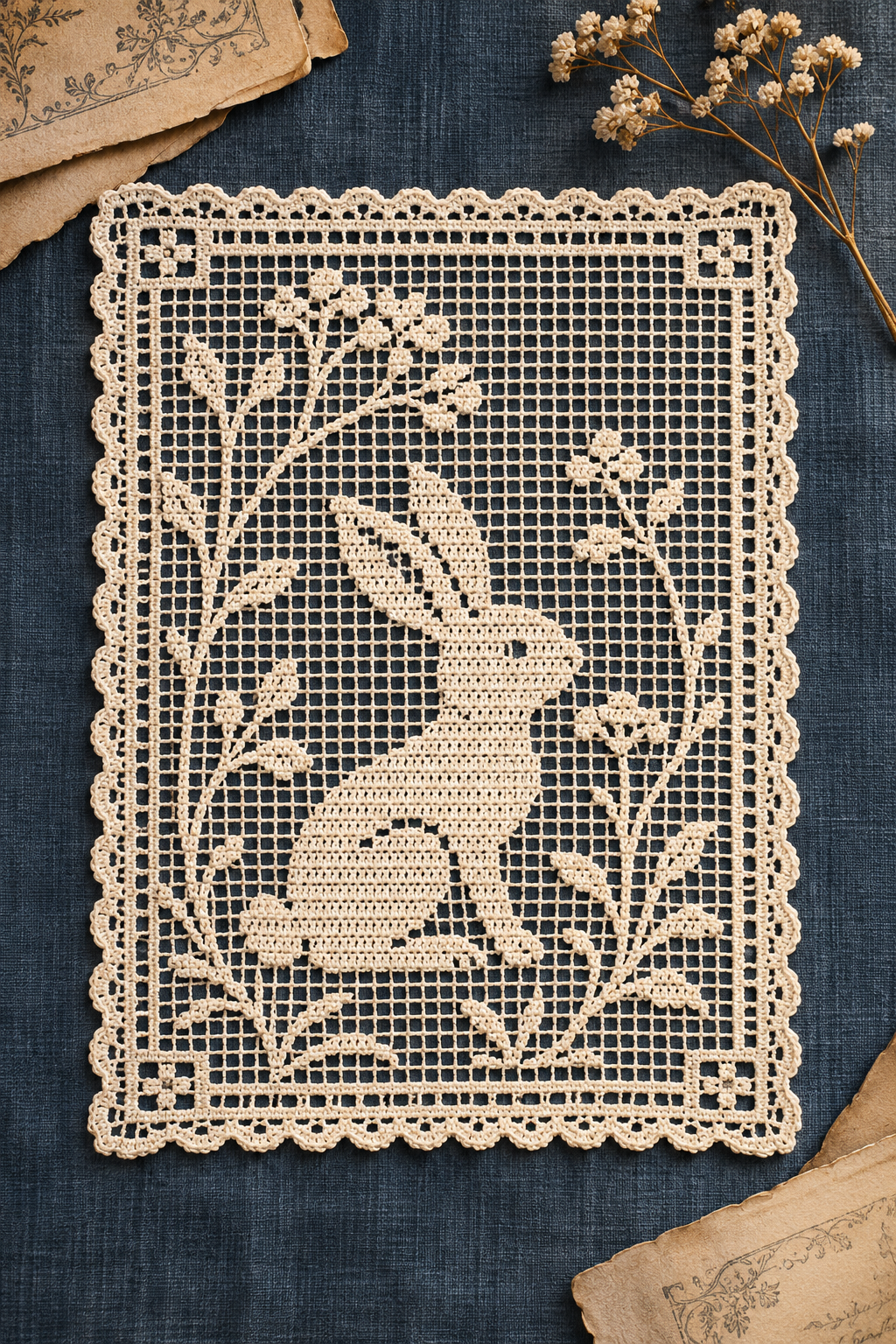
About the opening image: The featured artwork is an illustrative visualization inspired by the rabbit design. It is not a photograph of a newly crocheted sample or a stitch-accurate chart. The original 1915 sample photograph and the working charts appear below.
Why You’ll Love This Vintage Rabbit Pattern
It is a small, focused way to explore historical filet crochet: 24 cells across, a clear open-versus-filled chart, and a recognizable woodland motif that grows one row at a time. The narrow panel could appeal to makers who enjoy counted work and botanical or animal motifs. The instructions here are for the panel itself; any framing or additional project is your own choice.
Rabbit Filet Crochet Pattern at a Glance
Historical designerMary E. Fitch, 1915
Pattern typeFilet crochet rabbit panel
Chart79 rows, 24 cells per row
FoundationChain 80, turn, 1 d in 8th ch
Thread in sourceCrochet cotton Nos. 40 or 50
HookChoose to suit the thread; size not specified in the original
Yardage, gauge, finished sizeNot specified in the original
SkillsChains, US double crochet, turning rows, and reading a filet chart
Materials and Useful Tools
The historical recommendation is crochet cotton Nos. 40 or 50, with a hook chosen to suit that thread. No yardage, hook number, gauge, or finished dimensions are given. If you work with a different modern thread, the scale of the panel will change; sample your thread and hook before relying on a particular display size.
These optional supply links help with thread crochet and finishing, but none is presented as an exact substitute for the historical cotton:
- YarnArt Canarias mercerized lace cotton is a modern ultra-fine cotton option; compare its size and your swatch with the historical specification.
- Clover Amour fine crochet hook set offers fine metric hooks to test with your chosen thread; the source does not prescribe one hook size.
- Clover manual row counter can help you keep track of the 79 rows.
- KnitIQ blocking mats and stainless steel T-pins can support careful shaping if you decide to block the panel.
Some supply links above are affiliate links. Stella Crochet may earn a commission from qualifying purchases at no extra cost to you.
Notes Before You Begin
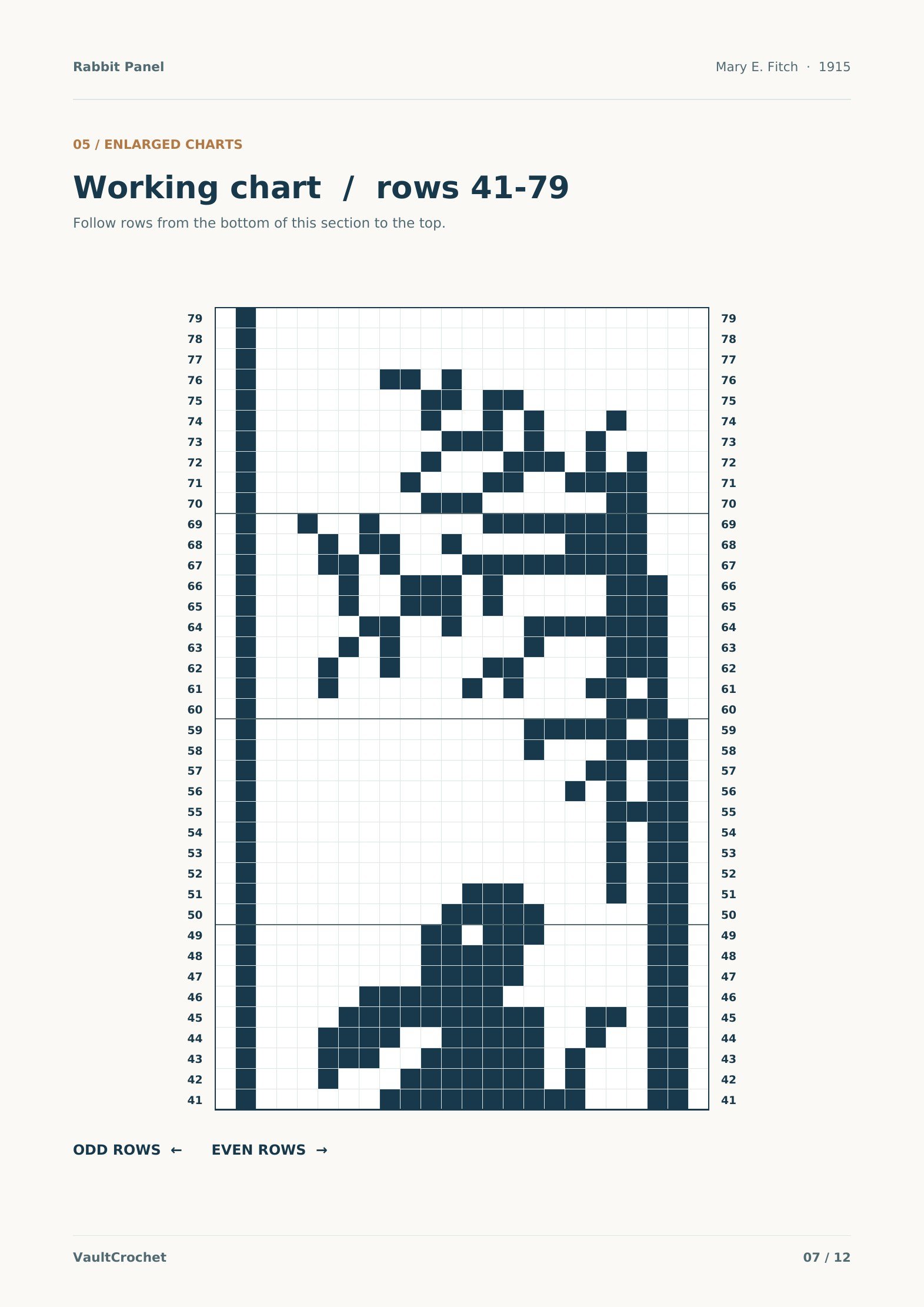
Keep the original shorthand in view: sp is an open space, while d is a double-crochet post in US terms. One open mesh reads as one sp on the chart. A run of 4 d makes one filled mesh; 7 d makes two filled meshes; 10 d makes three filled meshes. Adjacent filled cells share their boundary post. The written sequence for each row below is the working order, not a left-to-right transcription of every chart line.
The foundation instruction is Chain 80, turn, 1 d in 8th ch. From the 8th through the 80th chain are 73 positions: 24 cells × 3 intervals + 1 shared boundary post. After Rows 1–78, follow the printed ch 5; turn. Row 79 ends without another turn.
How to Read the Rabbit Filet Chart
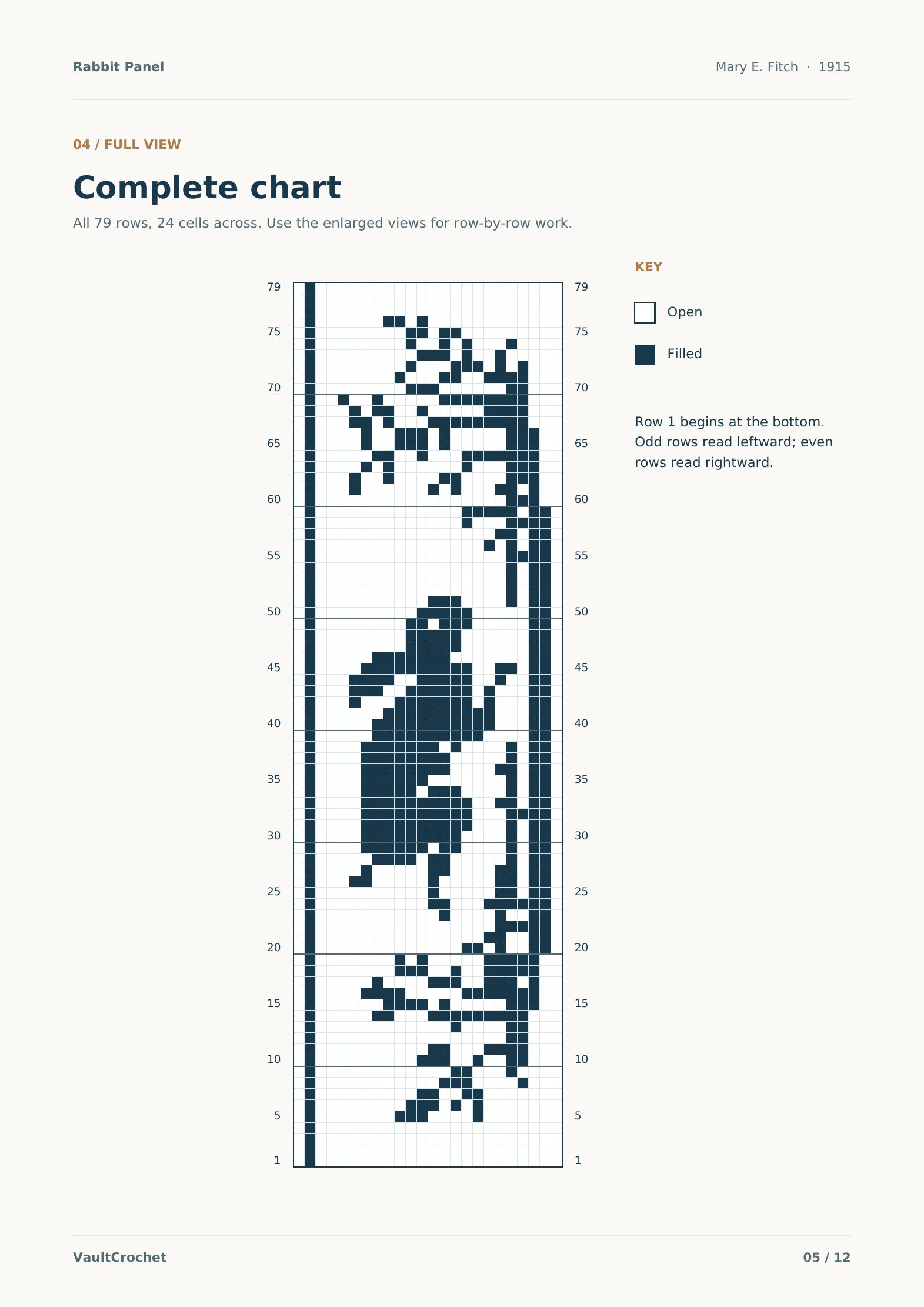
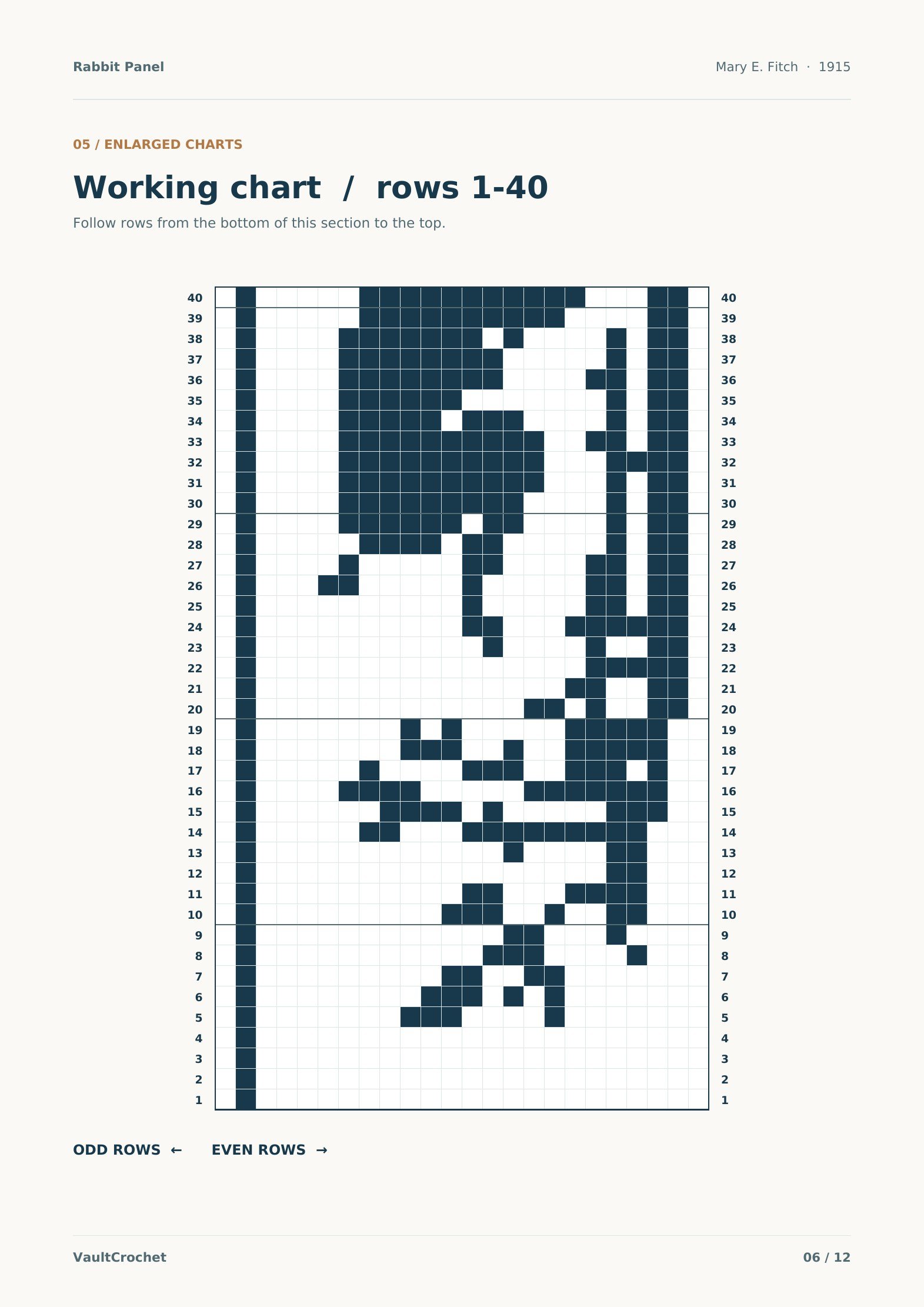
Begin at Row 1 at the bottom and move upward. Odd-numbered rows read leftward on this edition’s chart; even-numbered rows read rightward. Each row spans 24 cells. Use the full chart to see the composition, then the enlarged charts for Rows 1–40 and 41–79 to count individual spaces and filled blocks.
Complete Free Rabbit Filet Crochet Pattern
Foundation and Working Key
Foundation: Chain 80, turn, 1 d in 8th ch.
Every row below retains the source’s sp and d counts in working order. The arrow shows how that row travels across the chart: ← odd rows, → even rows.
Rows 01–20
- ← Row 01: 22 sp, 4 d, 1 sp, ch 5; turn.
- → Row 02: 1 sp, 4 d, 22 sp, ch 5; turn.
- ← Row 03: 22 sp, 4 d, 1 sp, ch 5; turn.
- → Row 04: 1 sp, 4 d, 22 sp, ch 5; turn.
- ← Row 05: 7 sp, 4 d, 4 sp, 10 d, 7 sp, 4 d, 1 sp, ch 5; turn.
- → Row 06: 1 sp, 4 d, 8 sp, 10 d, 1 sp, 4 d, 1 sp, 4 d, 7 sp, ch 5; turn.
- ← Row 07: 7 sp, 7 d, 2 sp, 7 d, 9 sp, 4 d, 1 sp, ch 5; turn.
- → Row 08: 1 sp, 4 d, 11 sp, 10 d, 4 sp, 4 d, 3 sp, ch 5; turn.
- ← Row 09: 4 sp, 4 d, 3 sp, 7 d, 12 sp, 4 d, 1 sp, ch 5; turn.
- → Row 10: 1 sp, 4 d, 9 sp, 10 d, 2 sp, 4 d, 2 sp, 7 d, 3 sp, ch 5; turn.
- ← Row 11: 3 sp, 13 d, 3 sp, 7 d, 10 sp, 4 d, 1 sp, ch 5; turn.
- → Row 12: 1 sp, 4 d, 17 sp, 7 d, 3 sp, ch 5; turn.
- ← Row 13: 3 sp, 7 d, 4 sp, 4 d, 12 sp, 4 d, 1 sp, ch 5; turn.
- → Row 14: 1 sp, 4 d, 5 sp, 7 d, 3 sp, 28 d, 3 sp, ch 5; turn.
- ← Row 15: 2 sp, 10 d, 5 sp, 4 d, 1 sp, 13 d, 6 sp, 4 d, 1 sp, ch 5; turn.
- → Row 16: 1 sp, 4 d, 4 sp, 13 d, 5 sp, 22 d, 2 sp, ch 5; turn.
- ← Row 17: 2 sp, 4 d, 1 sp, 10 d, 2 sp, 10 d, 4 sp, 4 d, 5 sp, 4 d, 1 sp, ch 5; turn.
- → Row 18: 1 sp, 4 d, 7 sp, 10 d, 2 sp, 4 d, 2 sp, 16 d, 2 sp, ch 5; turn.
- ← Row 19: 2 sp, 16 d, 5 sp, 4 d, 1 sp, 4 d, 7 sp, 4 d, 1 sp, ch 5; turn.
- → Row 20: 1 sp, 4 d, 13 sp, 7 d, 1 sp, 4 d, 2 sp, 7 d, 1 sp, ch 5; turn.
Rows 21–40
- ← Row 21: 1 sp, 7 d, 2 sp, 7 d, 15 sp, 4 d, 1 sp, ch 5; turn.
- → Row 22: 1 sp, 4 d, 16 sp, 16 d, 1 sp, ch 5; turn.
- ← Row 23: 1 sp, 7 d, 2 sp, 4 d, 4 sp, 4 d, 11 sp, 4 d, 1 sp, ch 5; turn.
- → Row 24: 1 sp, 4 d, 10 sp, 7 d, 3 sp, 19 d, 1 sp, ch 5; turn.
- ← Row 25: 1 sp, 7 d, 1 sp, 7 d, 5 sp, 4 d, 10 sp, 4 d, 1 sp, ch 5; turn.
- → Row 26: 1 sp, 4 d, 3 sp, 7 d, 5 sp, 4 d, 5 sp, 7 d, 1 sp, 7 d, 1 sp, ch 5; turn.
- ← Row 27: 1 sp, 7 d, 1 sp, 7 d, 4 sp, 7 d, 5 sp, 4 d, 4 sp, 4 d, 1 sp, ch 5; turn.
- → Row 28: 1 sp, 4 d, 5 sp, 13 d, 1 sp, 7 d, 5 sp, 4 d, 1 sp, 7 d, 1 sp, ch 5; turn.
- ← Row 29: 1 sp, 7 d, 1 sp, 4 d, 4 sp, 7 d, 1 sp, 19 d, 4 sp, 4 d, 1 sp, ch 5; turn.
- → Row 30: 1 sp, 4 d, 4 sp, 28 d, 4 sp, 4 d, 1 sp, 7 d, 1 sp, ch 5; turn.
- ← Row 31: 1 sp, 7 d, 1 sp, 4 d, 3 sp, 31 d, 4 sp, 4 d, 1 sp, ch 5; turn.
- → Row 32: 1 sp, 4 d, 4 sp, 31 d, 3 sp, 13 d, 1 sp, ch 5; turn.
- ← Row 33: 1 sp, 7 d, 1 sp, 7 d, 2 sp, 31 d, 4 sp, 4 d, 1 sp, ch 5; turn.
- → Row 34: 1 sp, 4 d, 4 sp, 16 d, 1 sp, 10 d, 4 sp, 4 d, 1 sp, 7 d, 1 sp, ch 5; turn.
- ← Row 35: 1 sp, 7 d, 1 sp, 4 d, 7 sp, 19 d, 4 sp, 4 d, 1 sp, ch 5; turn.
- → Row 36: 1 sp, 4 d, 4 sp, 25 d, 4 sp, 7 d, 1 sp, 7 d, 1 sp, ch 5; turn.
- ← Row 37: 1 sp, 7 d, 1 sp, 4 d, 5 sp, 25 d, 4 sp, 4 d, 1 sp, ch 5; turn.
- → Row 38: 1 sp, 4 d, 4 sp, 22 d, 1 sp, 4 d, 4 sp, 4 d, 1 sp, 7 d, 1 sp, ch 5; turn.
- ← Row 39: 1 sp, 7 d, 4 sp, 31 d, 5 sp, 4 d, 1 sp, ch 5; turn.
- → Row 40: 1 sp, 4 d, 5 sp, 34 d, 3 sp, 7 d, 1 sp, ch 5; turn.
Rows 41–60
- ← Row 41: 1 sp, 7 d, 3 sp, 31 d, 6 sp, 4 d, 1 sp, ch 5; turn.
- → Row 42: 1 sp, 4 d, 3 sp, 4 d, 3 sp, 22 d, 1 sp, 4 d, 3 sp, 7 d, 1 sp, ch 5; turn.
- ← Row 43: 1 sp, 7 d, 3 sp, 4 d, 1 sp, 19 d, 2 sp, 10 d, 3 sp, 4 d, 1 sp, ch 5; turn.
- → Row 44: 1 sp, 4 d, 3 sp, 13 d, 2 sp, 16 d, 2 sp, 4 d, 2 sp, 7 d, 1 sp, ch 5; turn.
- ← Row 45: 1 sp, 7 d, 1 sp, 7 d, 2 sp, 31 d, 4 sp, 4 d, 1 sp, ch 5; turn.
- → Row 46: 1 sp, 4 d, 5 sp, 22 d, 7 sp, 7 d, 1 sp, ch 5; turn.
- ← Row 47: 1 sp, 7 d, 6 sp, 16 d, 8 sp, 4 d, 1 sp, ch 5; turn.
- → Row 48: 1 sp, 4 d, 8 sp, 16 d, 6 sp, 7 d, 1 sp, ch 5; turn.
- ← Row 49: 1 sp, 7 d, 5 sp, 10 d, 1 sp, 7 d, 8 sp, 4 d, 1 sp, ch 5; turn.
- → Row 50: 1 sp, 4 d, 9 sp, 16 d, 5 sp, 7 d, 1 sp, ch 5; turn.
- ← Row 51: 1 sp, 7 d, 1 sp, 4 d, 4 sp, 10 d, 10 sp, 4 d, 1 sp, ch 5; turn.
- → Row 52: 1 sp, 4 d, 17 sp, 4 d, 1 sp, 7 d, 1 sp, ch 5; turn.
- ← Row 53: 1 sp, 7 d, 1 sp, 4 d, 17 sp, 4 d, 1 sp, ch 5; turn.
- → Row 54: 1 sp, 4 d, 17 sp, 4 d, 1 sp, 7 d, 1 sp, ch 5; turn.
- ← Row 55: 1 sp, 13 d, 17 sp, 4 d, 1 sp, ch 5; turn.
- → Row 56: 1 sp, 4 d, 15 sp, 4 d, 1 sp, 4 d, 1 sp, 7 d, 1 sp, ch 5; turn.
- ← Row 57: 1 sp, 7 d, 1 sp, 7 d, 16 sp, 4 d, 1 sp, ch 5; turn.
- → Row 58: 1 sp, 4 d, 13 sp, 4 d, 3 sp, 13 d, 1 sp, ch 5; turn.
- ← Row 59: 1 sp, 7 d, 1 sp, 16 d, 13 sp, 4 d, 1 sp, ch 5; turn.
- → Row 60: 1 sp, 4 d, 17 sp, 10 d, 2 sp, ch 5; turn.
Rows 61–79
- ← Row 61: 2 sp, 4 d, 1 sp, 7 d, 3 sp, 4 d, 1 sp, 4 d, 6 sp, 4 d, 3 sp, 4 d, 1 sp, ch 5; turn.
- → Row 62: 1 sp, 4 d, 3 sp, 4 d, 2 sp, 4 d, 4 sp, 7 d, 4 sp, 10 d, 2 sp, ch 5; turn.
- ← Row 63: 2 sp, 10 d, 3 sp, 4 d, 6 sp, 4 d, 1 sp, 4 d, 4 sp, 4 d, 1 sp, ch 5; turn.
- → Row 64: 1 sp, 4 d, 5 sp, 7 d, 2 sp, 4 d, 3 sp, 22 d, 2 sp, ch 5; turn.
- ← Row 65: 2 sp, 10 d, 5 sp, 4 d, 1 sp, 10 d, 2 sp, 4 d, 4 sp, 4 d, 1 sp, ch 5; turn.
- → Row 66: 1 sp, 4 d, 4 sp, 4 d, 2 sp, 10 d, 1 sp, 4 d, 5 sp, 10 d, 2 sp, ch 5; turn.
- ← Row 67: 3 sp, 28 d, 3 sp, 4 d, 1 sp, 7 d, 3 sp, 4 d, 1 sp, ch 5; turn.
- → Row 68: 1 sp, 4 d, 3 sp, 4 d, 1 sp, 7 d, 2 sp, 4 d, 5 sp, 13 d, 3 sp, ch 5; turn.
- ← Row 69: 3 sp, 25 d, 5 sp, 4 d, 2 sp, 4 d, 2 sp, 4 d, 1 sp, ch 5; turn.
- → Row 70: 1 sp, 4 d, 8 sp, 10 d, 6 sp, 7 d, 3 sp, ch 5; turn.
- ← Row 71: 3 sp, 13 d, 2 sp, 7 d, 3 sp, 4 d, 7 sp, 4 d, 1 sp, ch 5; turn.
- → Row 72: 1 sp, 4 d, 8 sp, 4 d, 3 sp, 10 d, 1 sp, 4 d, 1 sp, 4 d, 3 sp, ch 5; turn.
- ← Row 73: 5 sp, 4 d, 2 sp, 4 d, 1 sp, 10 d, 9 sp, 4 d, 1 sp, ch 5; turn.
- → Row 74: 1 sp, 4 d, 8 sp, 4 d, 2 sp, 4 d, 1 sp, 4 d, 3 sp, 4 d, 4 sp, ch 5; turn.
- ← Row 75: 9 sp, 7 d, 1 sp, 7 d, 8 sp, 4 d, 1 sp, ch 5; turn.
- → Row 76: 1 sp, 4 d, 6 sp, 7 d, 1 sp, 4 d, 12 sp, ch 5; turn.
- ← Row 77: 22 sp, 4 d, 1 sp, ch 5; turn.
- → Row 78: 1 sp, 4 d, 22 sp, ch 5; turn.
- ← Row 79: 22 sp, 4 d, 1 sp.
Finishing the Rabbit Panel
Fitch suggests placing the panel on linen or another material, working buttonhole stitch around it, cutting away the backing beneath the panel, and optionally finishing the edge with one or more rows of spaces.
That is the historical finishing suggestion, not a specified numeric edging pattern. If you choose a separate display method or blocking process, adapt it to your thread without adding it to the written 79-row design.
The Original 1915 Rabbit Design
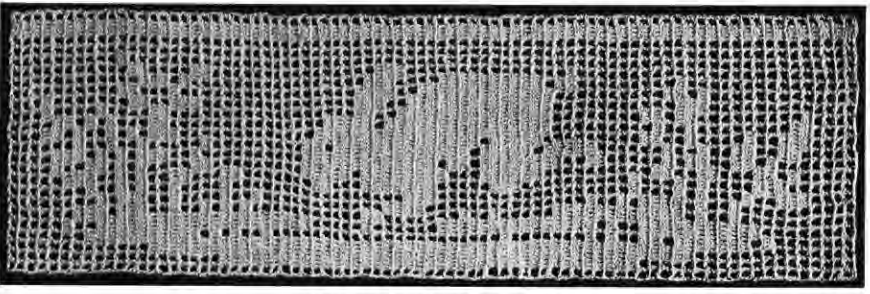
Mary E. Fitch published this panel in Filet Crochet with Instructions, Series No. 3 (1915), Figure 5, printed page 10. The historical photograph below documents the original sample; it is not a newly crocheted Stella Crochet piece. The approved edition supplies newly drawn charts and arranges the original row instructions for easier tracking.
Rabbit Filet Crochet FAQ
Is the full rabbit filet crochet pattern free here?
Yes. The foundation, all 79 written rows, the complete chart, both enlarged charts, and the historical finishing suggestion are available in this article.
What does “4 d” mean?
It is a run of four double-crochet posts across one filled mesh. Continuous runs of 7 d and 10 d cover two and three filled cells respectively because adjacent cells share a post.
Does the pattern specify a finished size?
No. The source gives 79 rows and 24 cells per row but does not specify gauge, yardage, or finished dimensions. Your thread, hook, tension, and finishing determine the final size.
Do I turn after Row 79?
No. Rows 1–78 end with ch 5; turn; the final Row 79 does not include another turn.
Is the opening image a finished sample?
No. The featured art is an illustrative visualization inspired by the motif. The black-and-white image above is the original 1915 sample photograph, and the charts above it are the working pattern.
More Historical Filet Crochet
For another animal motif with a very different scale, try our free peacock filet crochet pattern, a 98 × 98 mesh insert from 1911. You can also browse the Filet Crochet collection as the series grows or explore the complete Stella Crochet pattern library.
If you try this rabbit panel, share what you made and tell us how the chart worked for you. Did the motif emerge clearly as you counted the spaces? Was any instruction ambiguous, or did you change how you displayed the finished panel? Your experience can help another reader rediscover this 1915 design.
Leave a Reply