
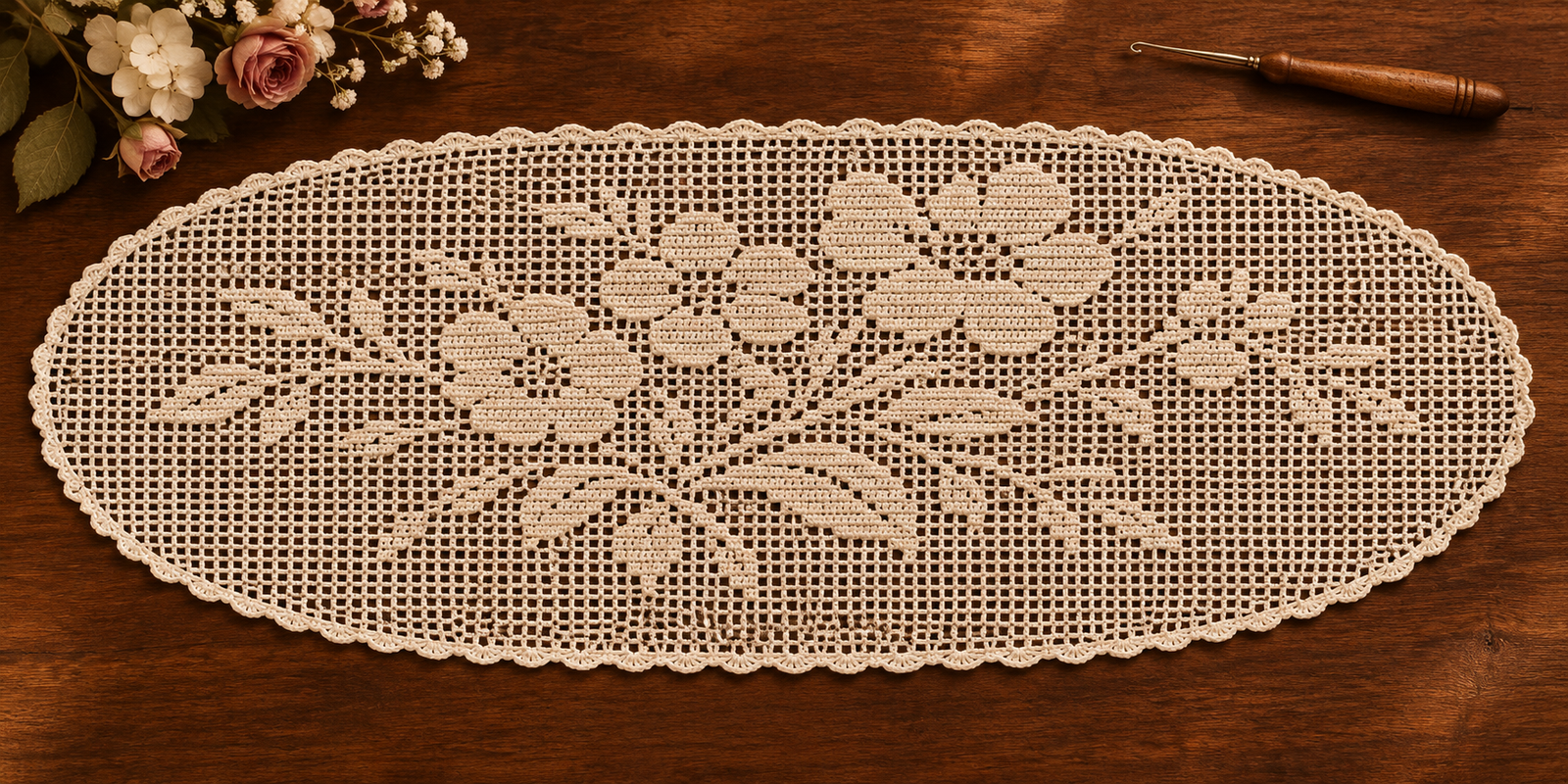
A Shaped Floral Oval Runner from 2000
Begin with six filet cells, widen into an airy floral oval, and taper the other end. The complete 70-row working map, original chart, and shaping method are all here.
Why You’ll Love This Pattern
This 2000 magazine design builds its oval by adding and removing filet cells at both edges. The result is a floral lace table accent with its shape worked into the fabric rather than simply cut around a rectangle. The original chart and the row map let you see exactly where the outline changes.
About the artwork: The featured image is an illustrative visualization inspired by the archival sample, not a newly crocheted or stitch-accurate piece. The original photograph and actual chart are below.
Pattern at a Glance
Materials and Tools
The source gives approximately 100 g white cotton yarn and a No. 1 crochet hook in its own notation. It does not specify a numeric gauge, yarn weight, hook diameter, or meterage. Swatch with your chosen supplies if the finished 60 × 30 cm estimate matters.
Useful modern supply options, offered as swatching and finishing choices rather than exact source equivalents:
- Lizbeth white cotton thread or YarnArt Canarias cotton thread.
- Clover fine hook set for choosing a hook by swatch rather than assuming a modern equivalent to historical No. 1.
- Clover row counter to track the shaping changes.
- Blocking mats with T-pins for the oval outline.
Some supply links are affiliate links. Stella Crochet may earn a commission from qualifying purchases at no extra cost to you.
Notes Before You Begin
Foundation / Row 1: Chain 19 + 5. Work 1 double crochet (dc) into the 4th foundation chain, then continue from the chart. The 19-chain foundation equals 6 × 3 + 1, matching six filet cells in Row 1. Keep the additional 5 chains exactly as printed.
Cell key: O = open cell, 2 chains + 1 dc. F = filled cell, 3 dc. Neighbouring cells share boundary posts. Row 1 is at the bottom of the printed chart; turn and alternate working direction on each row.
How to shape the oval
Each row begins with 3 turning chains counted as the first dc. End the row with 1 dc into the preceding row’s turning chain. The map is read from the start edge after turning.
Add at the start: The source gives 3 additional chains for each new cell, plus 3 turning chains. The charted outer cells are open, so their top needs 2 more chains. Rows 2, 3 and 4 begin with 14, 17 and 17 chains. For the 3n + 5 method, skip the first 8 chains, dc in the next; then ch 2, skip 2 and dc as each added open cell is formed before the old row.
Add at the end: Work a four-yarn-over post (US triple treble, trtr) into the attachment loop of the last post for the first new cell. For each further open cell, repeat 2 ch + trtr into the middle of the preceding trtr stem. This stem placement is the approved edition’s modern technical clarification and preserves the charted additions.
Decrease at the start: Move past the stitches corresponding to the removed cells with slip stitches, then work the remaining row from the chart. Decrease at the end: Leave removed cells unworked and turn for the next row.
For a planning estimate only, make a damp-blocked 10-cell × 10-row open-mesh swatch. Multiply its width by 56/10 for the broadest body width and its height by 70/10 for body length. Edges, tension, and the sc round affect the final outline.
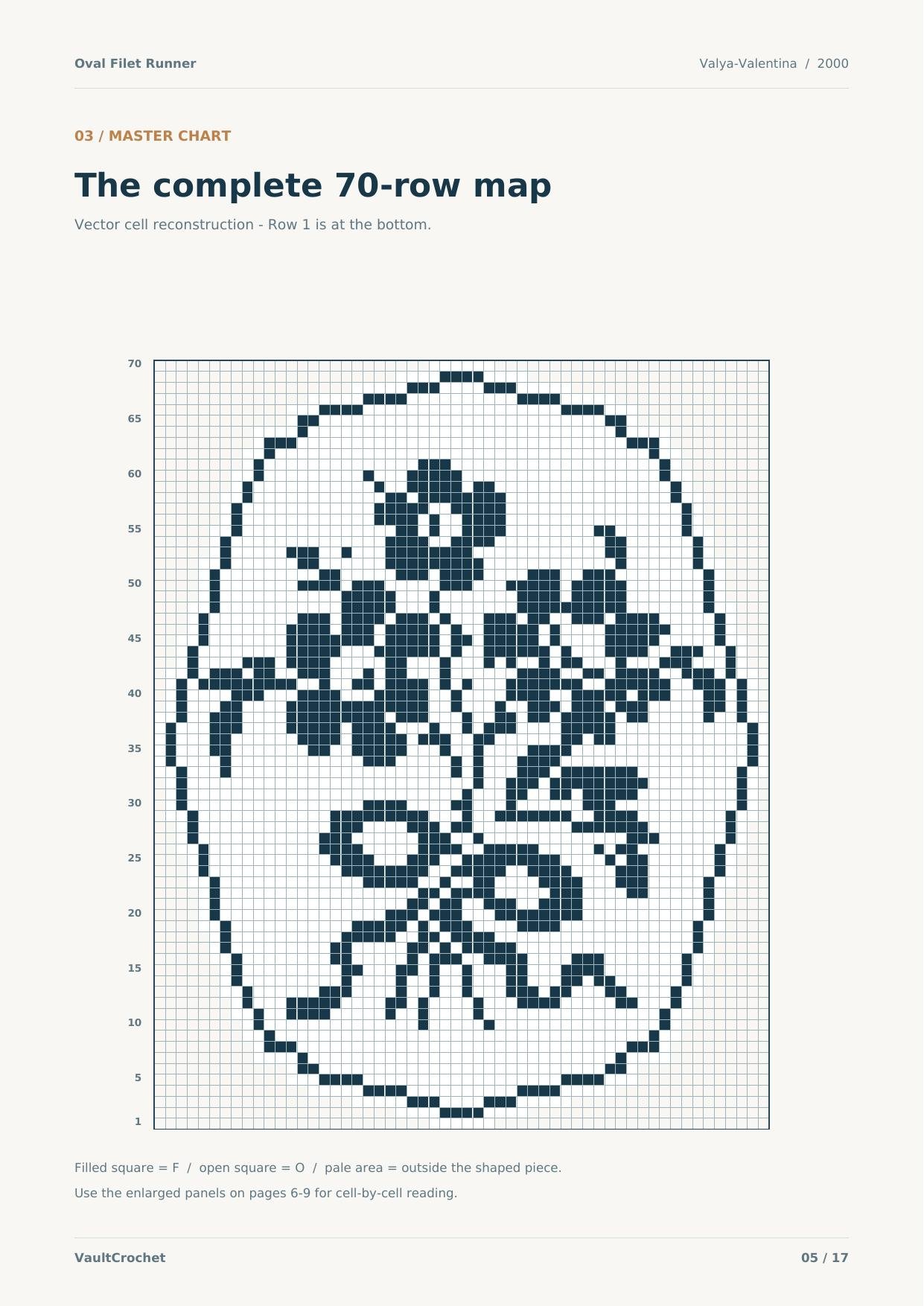
Read the Full Oval Filet Chart
The chart begins with Row 1 at the bottom and widens into the floral center. Every written row below states its cell width and the edge change on the paper chart. Enlarge the working chart to count each transition.
Follow Along Row by Row
Use Previous and Next, jump to any row, or enlarge the text. Your place and completed rows are stored in this browser; the complete pattern remains visible below.
Complete Free Oval Floral Filet Crochet Runner Pattern
All 70 written cell runs appear below in working direction. Each row states its cell count and the left and right changes as located on the paper chart; turn the work between rows. O is an open cell; F is filled.
Rows 1–10
- Row 01 · R→L · 6 cells · FOUNDATION / 6 cells: O6
- Row 02 · L→R · 12 cells · EDGE CHANGE left +3 / right +3: O4 F4 O4
- Row 03 · R→L · 20 cells · EDGE CHANGE left +4 / right +4: O5 F3 O4 F3 O5
- Row 04 · L→R · 28 cells · EDGE CHANGE left +4 / right +4: O5 F4 O10 F4 O5
- Row 05 · R→L · 32 cells · EDGE CHANGE left +2 / right +2: O3 F4 O18 F4 O3
- Row 06 · L→R · 32 cells · EDGE CHANGE left 0 / right 0: O1 F2 O26 F2 O1
- Row 07 · R→L · 38 cells · EDGE CHANGE left +3 / right +3: O4 F1 O28 F1 O4
- Row 08 · L→R · 38 cells · EDGE CHANGE left 0 / right 0: O1 F3 O30 F3 O1
- Row 09 · R→L · 40 cells · EDGE CHANGE left +1 / right +1: O2 F1 O34 F1 O2
- Row 10 · L→R · 40 cells · EDGE CHANGE left 0 / right 0: O1 F1 O14 F1 O5 F1 O15 F1 O1
Rows 11–20
- Row 11 · R→L · 42 cells · EDGE CHANGE left +1 / right +1: O2 F1 O16 F1 O4 F1 O2 F1 O5 F4 O2 F1 O2
- Row 12 · L→R · 42 cells · EDGE CHANGE left 0 / right 0: O1 F1 O3 F5 O4 F2 O1 F1 O4 F1 O3 F4 O5 F2 O3 F1 O1
- Row 13 · R→L · 44 cells · EDGE CHANGE left +1 / right +1: O2 F1 O4 F2 O3 F2 O1 F3 O3 F1 O2 F1 O2 F1 O4 F3 O6 F1 O2
- Row 14 · L→R · 44 cells · EDGE CHANGE left 0 / right 0: O1 F1 O9 F1 O4 F1 O2 F1 O2 F1 O3 F2 O3 F2 O1 F2 O6 F1 O1
- Row 15 · R→L · 44 cells · EDGE CHANGE left 0 / right 0: O1 F1 O7 F4 O3 F2 O3 F1 O2 F1 O1 F2 O3 F2 O9 F1 O1
- Row 16 · L→R · 46 cells · EDGE CHANGE left +1 / right +1: O2 F1 O8 F2 O5 F1 O1 F3 O2 F4 O4 F3 O7 F1 O2
- Row 17 · R→L · 46 cells · EDGE CHANGE left 0 / right 0: O1 F1 O16 F5 O1 F1 O1 F2 O5 F2 O9 F1 O1
- Row 18 · L→R · 46 cells · EDGE CHANGE left 0 / right 0: O1 F1 O10 F5 O2 F2 O1 F4 O18 F1 O1
- Row 19 · R→L · 48 cells · EDGE CHANGE left +1 / right +1: O2 F1 O12 F4 O4 F3 O1 F1 O1 F5 O11 F1 O2
- Row 20 · L→R · 48 cells · EDGE CHANGE left 0 / right 0: O1 F1 O15 F3 O1 F3 O3 F8 O11 F1 O1
Rows 21–30
- Row 21 · R→L · 48 cells · EDGE CHANGE left 0 / right 0: O1 F1 O11 F4 O2 F3 O2 F2 O1 F2 O17 F1 O1
- Row 22 · L→R · 48 cells · EDGE CHANGE left 0 / right 0: O1 F1 O18 F2 O1 F4 O5 F3 O4 F2 O5 F1 O1
- Row 23 · R→L · 50 cells · EDGE CHANGE left +1 / right +1: O2 F1 O5 F3 O3 F4 O4 F2 O2 F1 O2 F5 O13 F1 O2
- Row 24 · L→R · 50 cells · EDGE CHANGE left 0 / right 0: O1 F1 O12 F8 O2 F5 O2 F4 O4 F3 O6 F1 O1
- Row 25 · R→L · 50 cells · EDGE CHANGE left 0 / right 0: O1 F1 O6 F2 O1 F1 O4 F9 O2 F3 O3 F4 O11 F1 O1
- Row 26 · L→R · 52 cells · EDGE CHANGE left +1 / right +1: O2 F1 O10 F4 O5 F4 O2 F5 O5 F1 O1 F2 O7 F1 O2
- Row 27 · R→L · 52 cells · EDGE CHANGE left 0 / right 0: O1 F1 O6 F3 O13 F1 O2 F3 O6 F3 O11 F1 O1
- Row 28 · L→R · 52 cells · EDGE CHANGE left 0 / right 0: O1 F1 O12 F3 O4 F3 O1 F2 O9 F7 O7 F1 O1
- Row 29 · R→L · 54 cells · EDGE CHANGE left +1 / right +1: O2 F1 O8 F4 O2 F7 O2 F1 O3 F9 O12 F1 O2
- Row 30 · L→R · 54 cells · EDGE CHANGE left 0 / right 0: O1 F1 O16 F4 O4 F2 O3 F1 O6 F3 O11 F1 O1
Rows 31–40
- Row 31 · R→L · 54 cells · EDGE CHANGE left 0 / right 0: O1 F1 O9 F5 O1 F2 O2 F2 O3 F1 O25 F1 O1
- Row 32 · L→R · 54 cells · EDGE CHANGE left 0 / right 0: O1 F1 O26 F1 O2 F3 O1 F9 O8 F1 O1
- Row 33 · R→L · 56 cells · EDGE CHANGE left +1 / right +1: O2 F1 O9 F7 O1 F3 O3 F1 O1 F1 O20 F1 O3 F1 O2
- Row 34 · L→R · 56 cells · EDGE CHANGE left 0 / right 0: O1 F1 O4 F1 O12 F3 O5 F1 O1 F1 O3 F4 O17 F1 O1
- Row 35 · R→L · 56 cells · EDGE CHANGE left 0 / right 0: O1 F1 O16 F4 O4 F1 O2 F1 O3 F5 O2 F2 O7 F2 O3 F1 O1
- Row 36 · L→R · 56 cells · EDGE CHANGE left 0 / right 0: O1 F1 O3 F2 O6 F4 O1 F5 O1 F3 O2 F2 O6 F2 O1 F2 O12 F1 O1
- Row 37 · R→L · 56 cells · EDGE CHANGE left 0 / right 0: O1 F1 O12 F5 O4 F3 O1 F1 O2 F1 O3 F4 O1 F5 O4 F3 O3 F1 O1
- Row 38 · L→R · 56 cells · EDGE CHANGE left 0 / right 0: O2 F1 O2 F3 O4 F9 O1 F3 O3 F1 O2 F2 O1 F2 O1 F5 O1 F2 O5 F1 O2 F1 O2
- Row 39 · R→L · 54 cells · EDGE CHANGE left -1 / right -1: O1 F1 O1 F2 O5 F3 O1 F3 O1 F3 O2 F1 O3 F1 O2 F13 O4 F2 O3 F1 O1
- Row 40 · L→R · 54 cells · EDGE CHANGE left 0 / right 0: O1 F1 O4 F3 O3 F4 O3 F5 O2 F1 O4 F4 O2 F5 O1 F3 O3 F2 O1 F1 O1
Rows 41–50
- Row 41 · R→L · 54 cells · EDGE CHANGE left 0 / right 0: O1 F1 O1 F3 O2 F6 O2 F7 O3 F1 O1 F1 O1 F4 O1 F2 O2 F1 O2 F9 O1 F1 O1
- Row 42 · L→R · 54 cells · EDGE CHANGE left 0 / right 0: O2 F1 O1 F3 O1 F2 O2 F3 O3 F1 O1 F2 O3 F1 O6 F4 O2 F2 O1 F4 O2 F3 O1 F1 O2
- Row 43 · R→L · 52 cells · EDGE CHANGE left -1 / right -1: O1 F1 O3 F3 O3 F1 O3 F2 O1 F1 O2 F1 O1 F1 O3 F1 O3 F2 O5 F4 O1 F3 O4 F1 O1
- Row 44 · L→R · 52 cells · EDGE CHANGE left 0 / right 0: O1 F1 O8 F5 O3 F6 O1 F1 O2 F6 O1 F1 O3 F4 O2 F3 O2 F1 O1
- Row 45 · R→L · 52 cells · EDGE CHANGE left 0 / right 0: O2 F1 O5 F5 O4 F1 O1 F5 O1 F2 O1 F5 O1 F8 O7 F1 O2
- Row 46 · L→R · 50 cells · EDGE CHANGE left -1 / right -1: O1 F1 O7 F4 O1 F3 O1 F5 O1 F1 O2 F5 O1 F1 O4 F6 O4 F1 O1
- Row 47 · R→L · 50 cells · EDGE CHANGE left 0 / right 0: O1 F1 O5 F4 O1 F3 O2 F2 O1 F3 O3 F1 O1 F3 O1 F4 O1 F3 O8 F1 O1
- Row 48 · L→R · 50 cells · EDGE CHANGE left 0 / right 0: O2 F1 O11 F5 O3 F1 O7 F10 O7 F1 O2
- Row 49 · R→L · 48 cells · EDGE CHANGE left -1 / right -1: O1 F1 O7 F5 O1 F4 O7 F1 O3 F5 O11 F1 O1
- Row 50 · L→R · 48 cells · EDGE CHANGE left 0 / right 0: O1 F1 O7 F4 O1 F3 O5 F3 O3 F5 O1 F5 O7 F1 O1
Rows 51–60
- Row 51 · R→L · 48 cells · EDGE CHANGE left 0 / right 0: O1 F1 O8 F3 O2 F3 O4 F4 O1 F3 O5 F2 O9 F1 O1
- Row 52 · L→R · 48 cells · EDGE CHANGE left 0 / right 0: O2 F1 O6 F2 O6 F9 O12 F1 O6 F1 O2
- Row 53 · R→L · 46 cells · EDGE CHANGE left -1 / right -1: O1 F1 O6 F2 O12 F8 O3 F1 O2 F3 O5 F1 O1
- Row 54 · L→R · 46 cells · EDGE CHANGE left 0 / right 0: O1 F1 O14 F4 O2 F4 O10 F2 O6 F1 O1
- Row 55 · R→L · 46 cells · EDGE CHANGE left 0 / right 0: O2 F1 O6 F2 O8 F4 O2 F1 O1 F2 O14 F1 O2
- Row 56 · L→R · 44 cells · EDGE CHANGE left -1 / right -1: O1 F1 O12 F4 O1 F1 O2 F4 O16 F1 O1
- Row 57 · R→L · 44 cells · EDGE CHANGE left 0 / right 0: O1 F1 O16 F5 O2 F5 O12 F1 O1
- Row 58 · L→R · 44 cells · EDGE CHANGE left 0 / right 0: O2 F1 O12 F2 O1 F8 O15 F1 O2
- Row 59 · R→L · 42 cells · EDGE CHANGE left -1 / right -1: O1 F1 O16 F2 O1 F5 O2 F1 O11 F1 O1
- Row 60 · L→R · 42 cells · EDGE CHANGE left 0 / right 0: O2 F1 O9 F1 O3 F5 O18 F1 O2
Rows 61–70
- Row 61 · R→L · 40 cells · EDGE CHANGE left -1 / right -1: O1 F1 O19 F3 O14 F1 O1
- Row 62 · L→R · 40 cells · EDGE CHANGE left 0 / right 0: O2 F1 O34 F1 O2
- Row 63 · R→L · 38 cells · EDGE CHANGE left -1 / right -1: O1 F3 O30 F3 O1
- Row 64 · L→R · 38 cells · EDGE CHANGE left 0 / right 0: O4 F1 O28 F1 O4
- Row 65 · R→L · 32 cells · EDGE CHANGE left -3 / right -3: O1 F2 O26 F2 O1
- Row 66 · L→R · 32 cells · EDGE CHANGE left 0 / right 0: O3 F4 O18 F4 O3
- Row 67 · R→L · 28 cells · EDGE CHANGE left -2 / right -2: O5 F4 O10 F4 O5
- Row 68 · L→R · 20 cells · EDGE CHANGE left -4 / right -4: O5 F3 O4 F3 O5
- Row 69 · R→L · 12 cells · EDGE CHANGE left -4 / right -4: O4 F4 O4
- Row 70 · L→R · 6 cells · EDGE CHANGE left -3 / right -3: O6
One-Round Edging and Blocking
After Row 70: Work single crochet (sc) around the piece. At the corners, work 3 sc into one chain so the work does not pull in. The magazine does not give a fixed stitch count for each side or each corner position.
Finish: Stretch the runner to the intended size, dampen it, and allow it to dry. The source gives no additional decorative border or further round.
The perimeter follows the stepped filet outline shown on the complete chart. Distribute the stated sc round along that edge so the textile lies flat; no numerical spacing rule is assigned by the magazine.
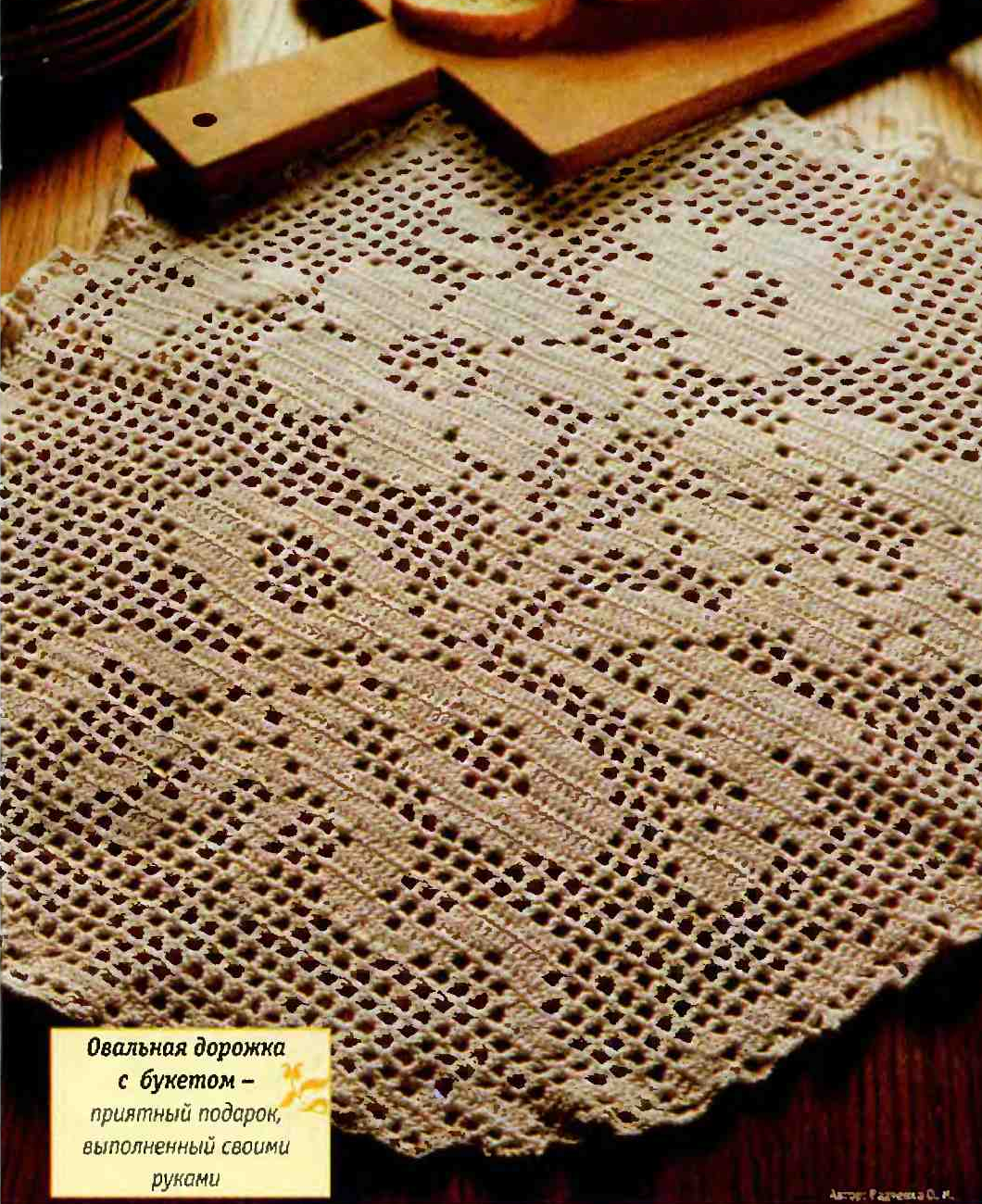
Historical Photograph
This is the archival photograph from the September 2000 magazine. It shows the actual original textile and is distinct from the featured visualization.
Oval Filet Crochet FAQs
Is this a complete free pattern?
Yes. The article includes the foundation, shaping method, all 70 working rows, full chart, one-round edging, and finishing.
Why do row widths change?
The oval is made by adding open filet cells at both ends and then decreasing them. Every row below names its width and chart-edge changes.
What is the finished size?
Approximately 60 × 30 cm in the source; no numeric gauge is supplied.
What does trtr mean here?
It is the US triple treble, a four-yarn-over post used to extend open cells at the end of a shaped row.
More Free Filet Crochet Patterns
Continue with the snowflake filet runner, the German motif runner, and the square filet doily. Browse the Filet Crochet collection for more free projects.
Try shaping the oval and share your result. Did the widening and tapering work as you expected? Tell us if a step was unclear or if you changed the final blocking, so other readers can benefit.
Leave a Reply