Eight Bird Squares, One Vintage Lace Textile
Make a bird motif from the 1994 stitch chart, edge and join eight or more squares, then work the original outer border. The complete chart and border diagrams are included here, with a row navigator for the intricate bird motif.
Why You’ll Love This Pattern
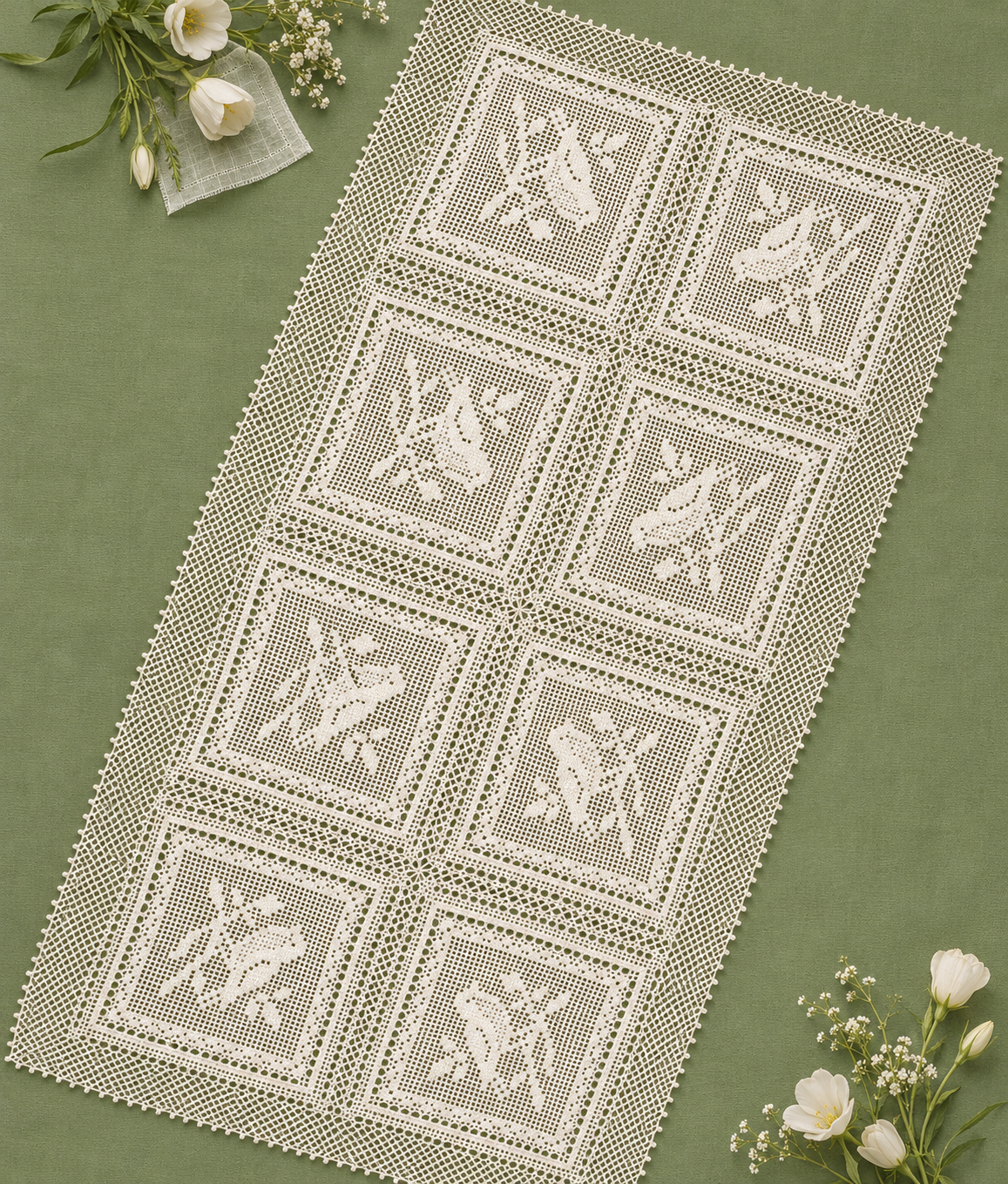
Instead of a single long filet panel, this 1994 design grows one square at a time. Eight bird motifs make the photographed two-by-four textile, while the source permits more motifs and a different overall shape. The wings and body are worked with mixed stitch glyphs, so the original chart matters as much as the familiar open-and-filled cells.
Image note: The featured picture is an illustrative visualization inspired by the historical sample, not a newly crocheted or stitch-accurate textile. The original magazine photograph and all working charts appear below.
Pattern at a Glance
Materials and Tools
Use the source quantities: 200 g white 100% cotton, approximately 400 m per 50 g, and a No. 1 crochet hook, nominally 1 mm. Swatch to match the historical 16-cell by 16-row gauge if the pictured 110 × 67 cm size matters.
Optional modern supplies to compare and use:
- Lizbeth cotton thread or YarnArt Canarias thread; compare meterage and make a gauge swatch.
- Clover fine crochet hooks for trying the specified hook range.
- Clover row counter for each motif.
- Blocking mats and T-pins to set each picot.
Some supply links are affiliate links. Stella Crochet may earn a commission from qualifying purchases at no extra cost to you.
Notes Before You Begin
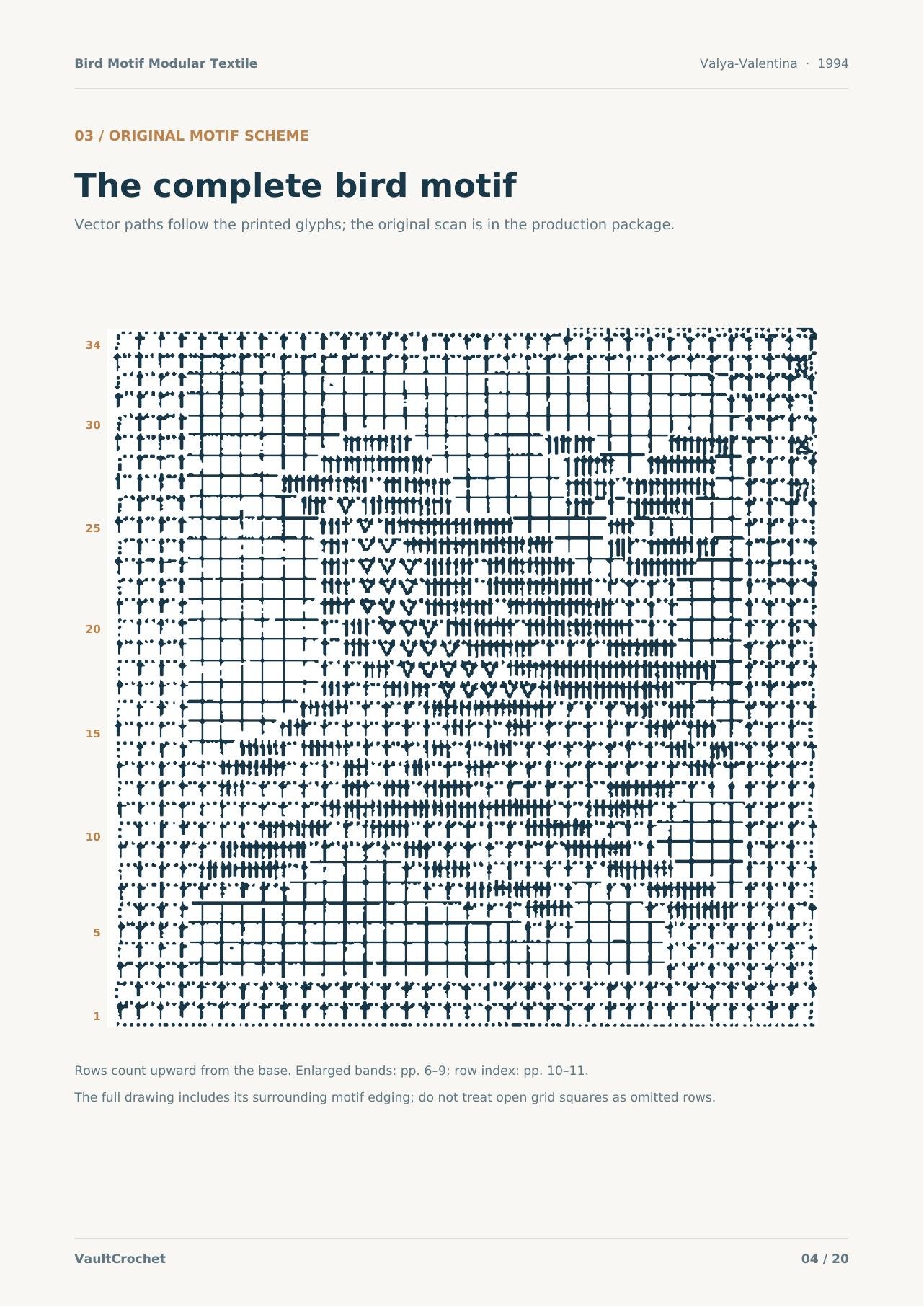
Foundation for each motif: 103 chains + 3 turning chains = 106 chains, yielding 34 filet cells. Follow the complete motif scheme and filet pattern II from the magazine.
Filet pattern II: An open cell is 1 double crochet and 2 chains; a filled cell is 3 double crochets, with shared boundary posts. The bird chart also contains drawn stitch glyphs, which take precedence where they appear. The source legend defines ch, slip stitch (sl st), single crochet (sc), treble crochet (tr, two yarn overs), and a picot of 4 chains followed by a slip stitch into the first chain.
Shared-base V groups: Symbols joined at the bottom are posts worked in one foundation loop. Keep their arms and adjacent chains in the drawn positions. The source does not give a reliable prose stitch total for every row with these groups, so use the actual chart rather than inventing numeric instructions.
Complete Bird Motif and Enlarged Chart Bands
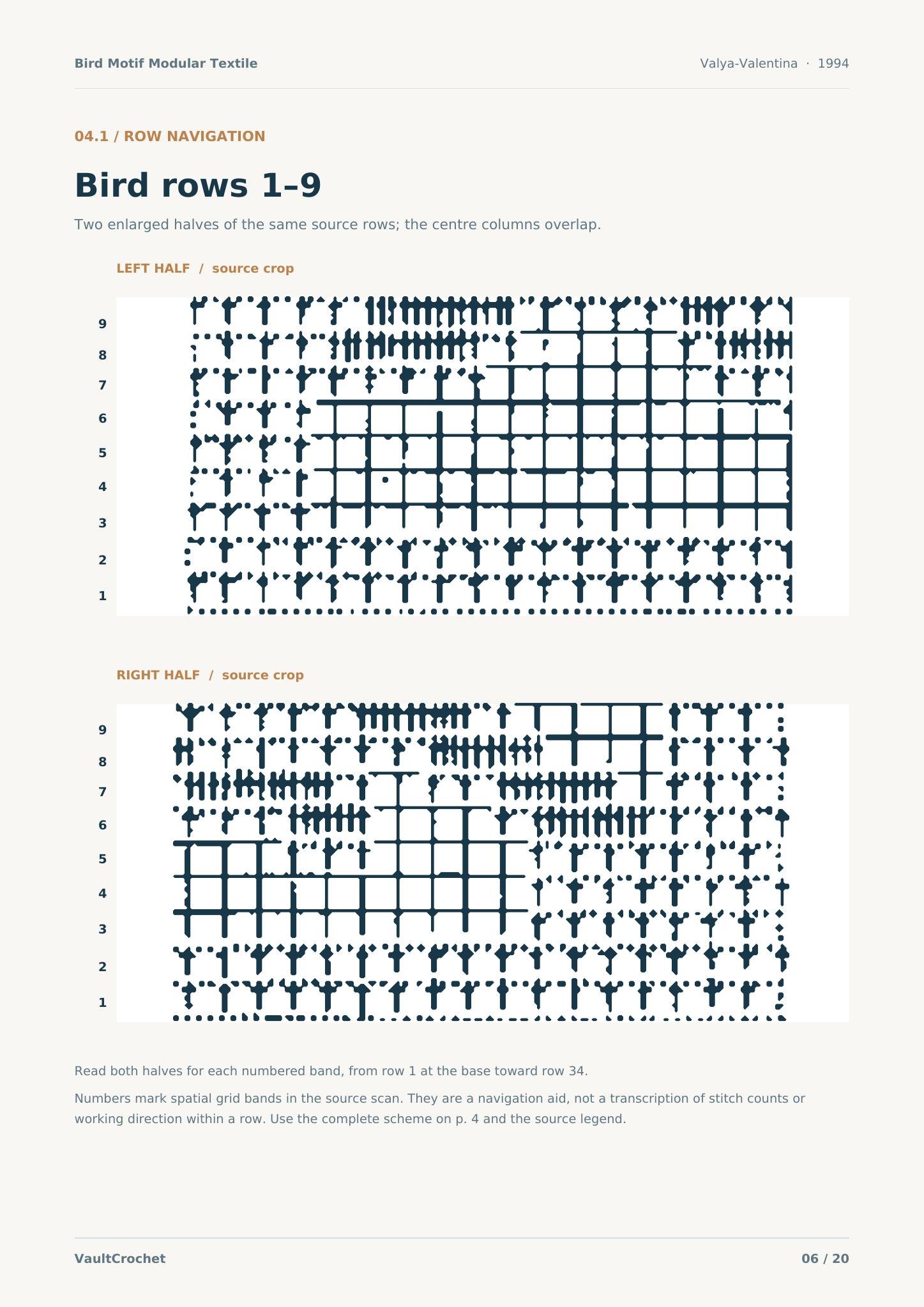
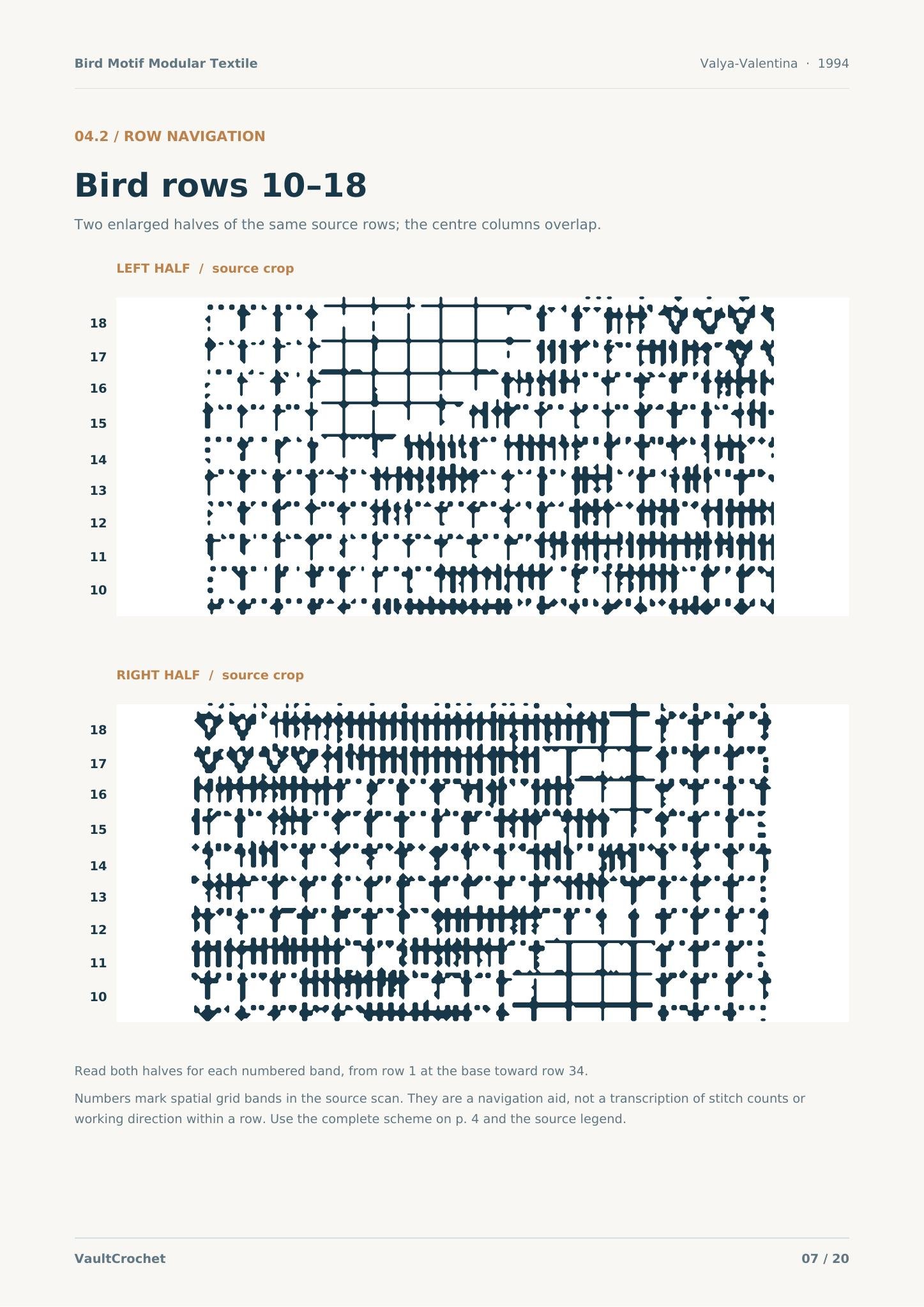
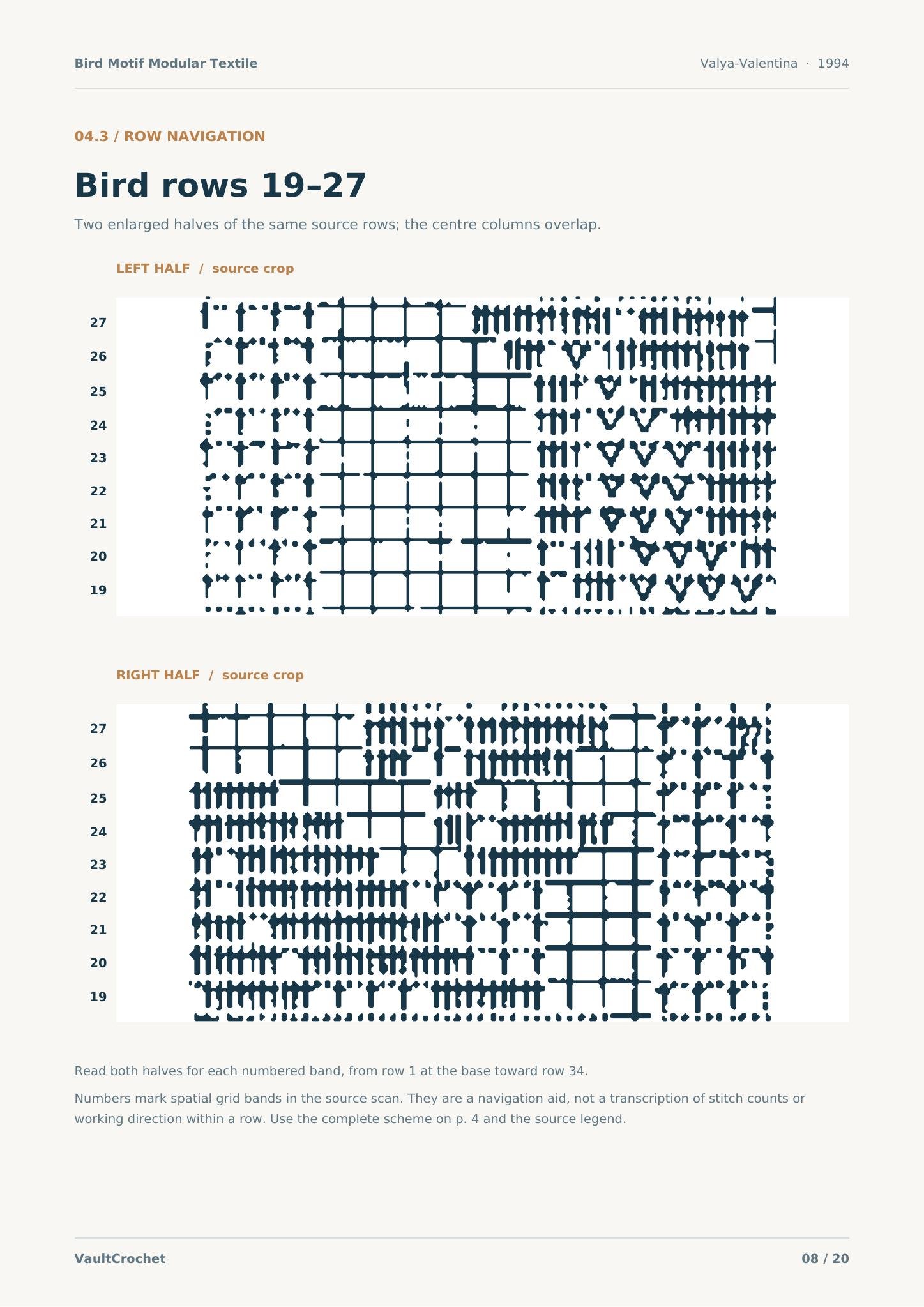
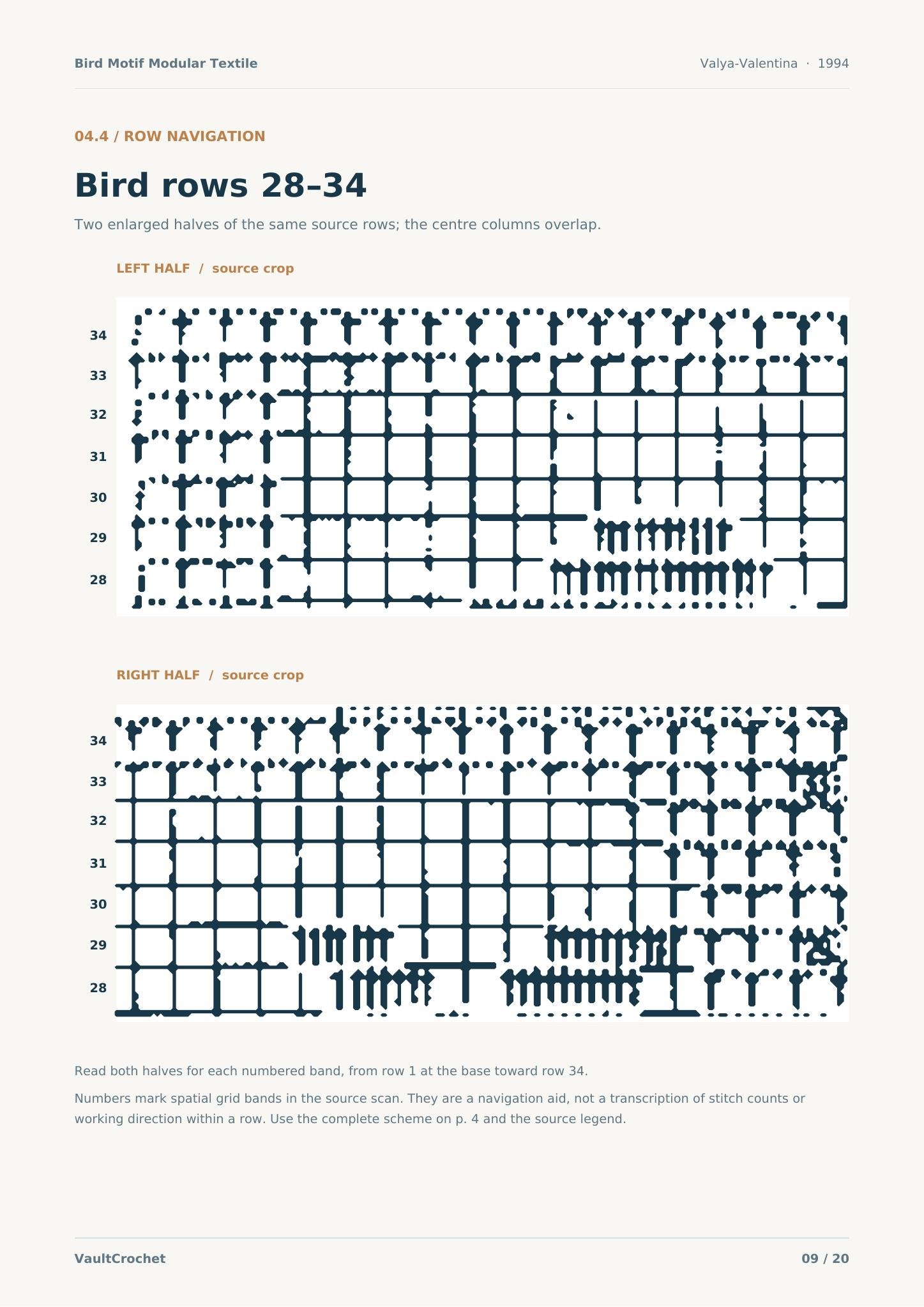
The chart itself gives the stitch-level instructions for each bird square. Rows 1–34 build the motif. The enlarged bands are reading aids for its lower, middle, and upper details; open each image at full size and follow both halves of a band.
Follow the Bird Motif Row by Row
Previous and Next guide your place through the 34 chart bands. This reader identifies the relevant source glyph families and chart band; the diagram is the working instruction. It does not substitute invented numerical stitch runs for the shared-base V symbols.
Full Bird Motif Modular Textile Pattern
1. Make each bird square
Start with 103 chains + 3 turning chains = 106 chains. Work the 34-cell-wide bird motif from the complete chart above, beginning with Row 1 at the base and following its actual stitch symbols. The V-shaped shared-base posts in rows 17–26 are not ordinary filled-cell counts; use the enlarged rows and source legend.
2. Edge each motif, rows 35–45
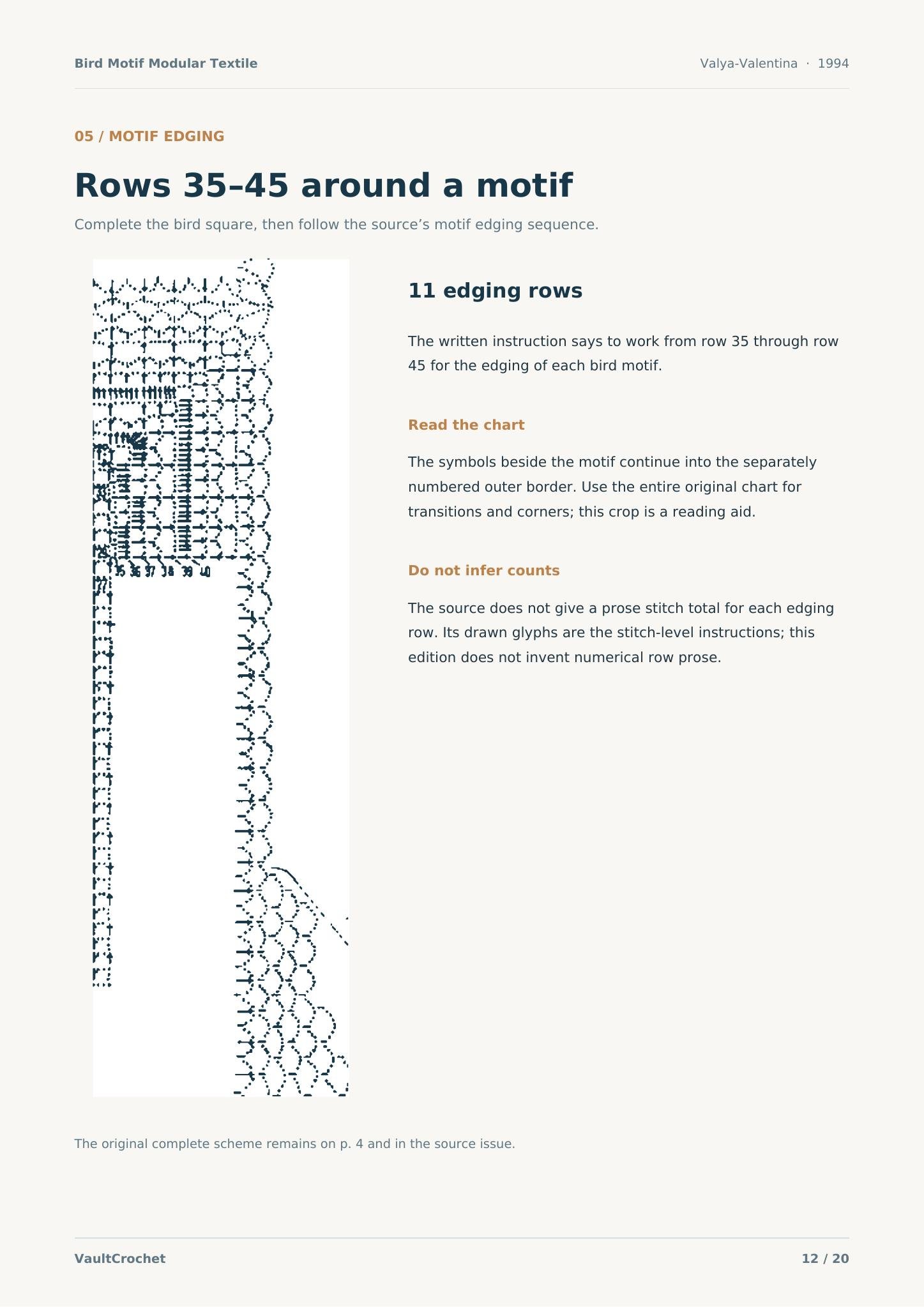
Follow the motif edging scheme for rows 35 through 45 inclusive. The drawn glyphs show the stitch-level transitions and corners; the source does not give a prose total for each edging row. Make eight or more motifs.
3. Join the motifs
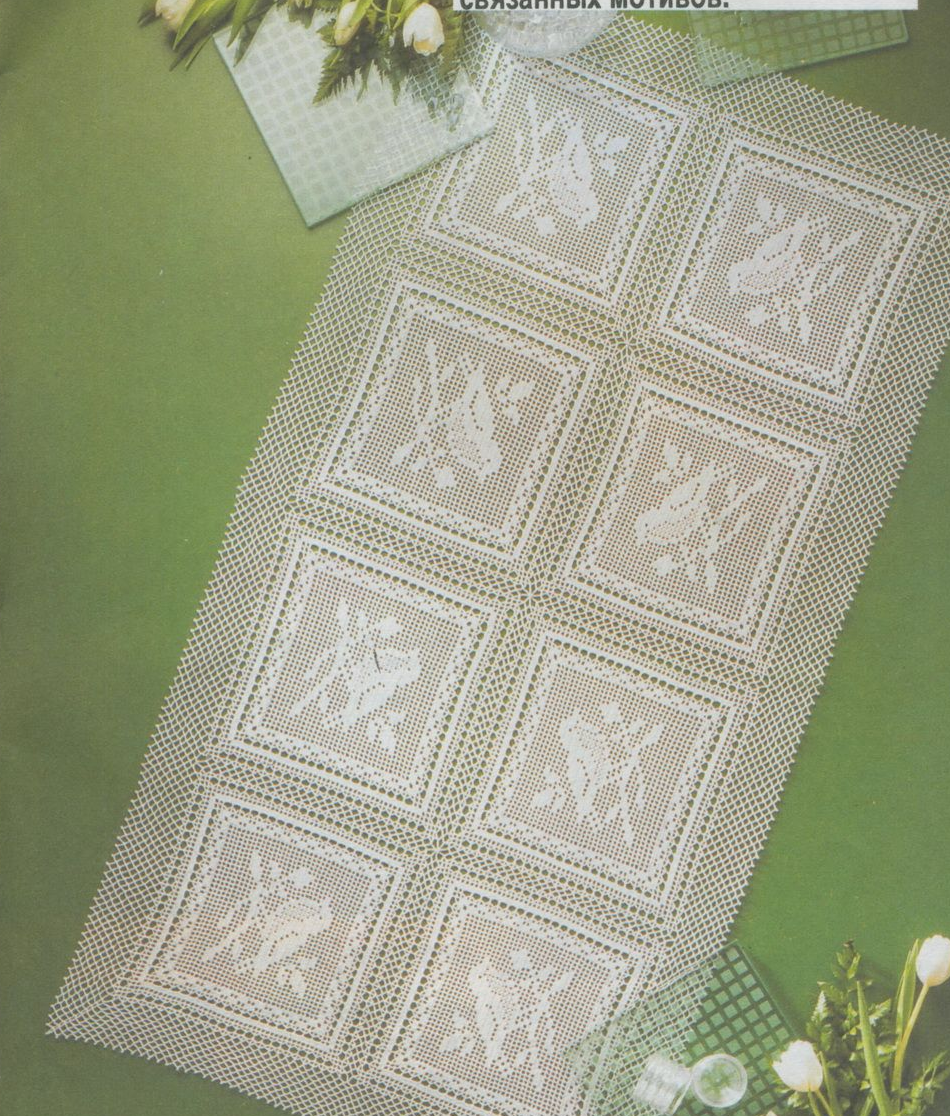
For the photographed example, arrange eight bird squares in two columns and four rows. Sew neighboring motifs with inconspicuous stitches, or join each motif to its neighbor with slip stitches during its final edging row (row 45). The source gives no seam-by-seam stitch count, fixed slip-stitch interval, joining order, or prescribed bird orientation. Other motif counts and arrangements are permitted.
4. Work the outer border, rows 46–55
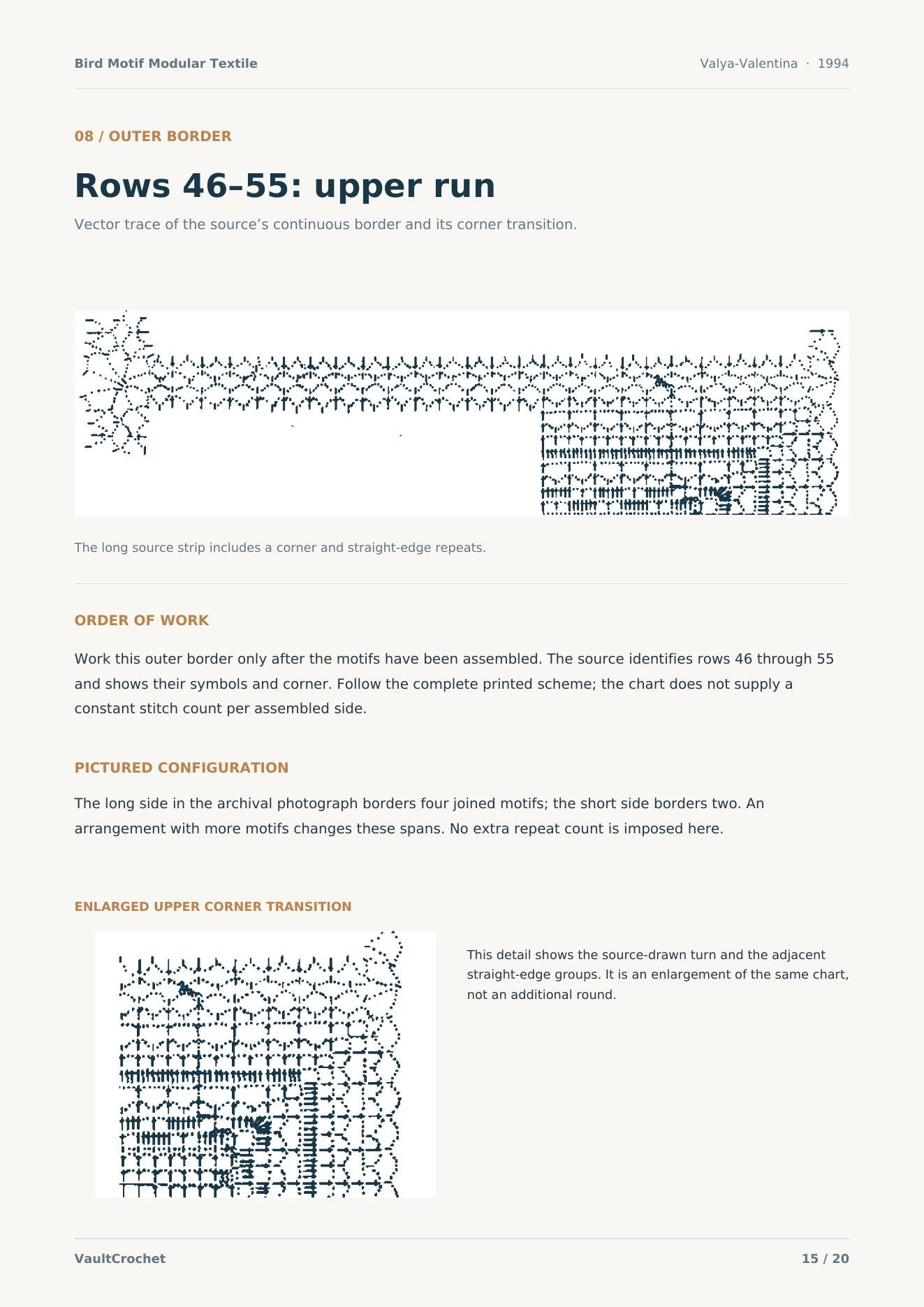
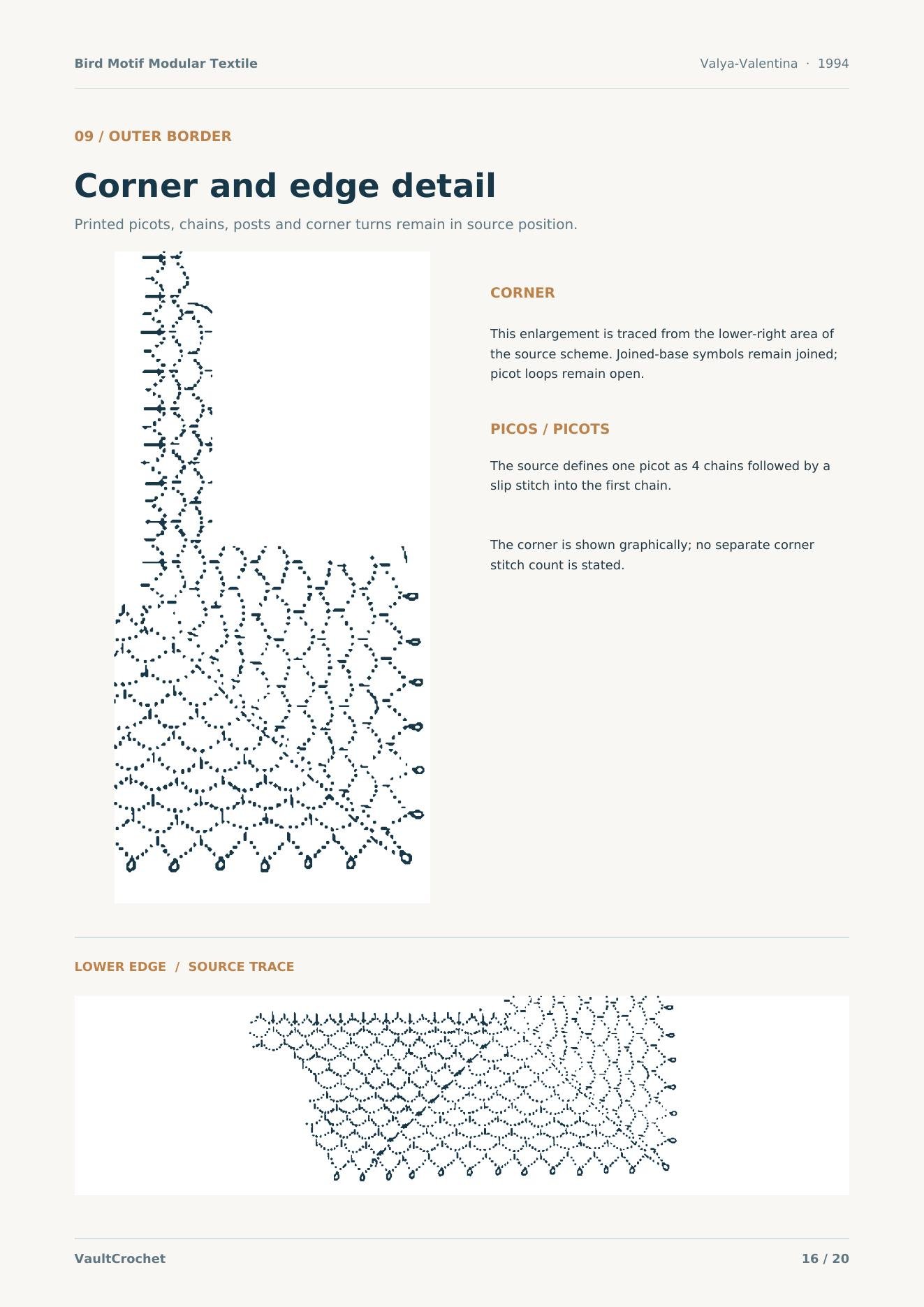
After assembly, follow the continuous source border scheme for rows 46 through 55, including its drawn straight repeats and corner transitions. The chart does not supply a constant stitch count per assembled side. Picot in the source legend: 4 chains, then a slip stitch into the first chain.
5. Finish
Lightly starch the textile, stretch it to size, pin every picot, then dry under a damp cloth or steam.
Reading the Border and Picots
The motif edging (35–45) belongs to each square. The outer border (46–55) belongs to the joined cloth. Follow the complete diagrams above in that order. The source legend says a picot is 4 chains followed by a slip stitch into the first chain; no new repeat or corner count is imposed.
The Historical Eight-Motif Textile
This is the archival photograph from the 1994 magazine. It shows eight bird motifs in the two-by-four layout; the featured image is a separate visualization.
Bird Filet Crochet FAQs
Is this a complete free chart pattern?
Yes. The motif scheme, enlarged bands, edging and outer-border diagrams, materials, construction, joins, and finishing are on this page. The source uses mixed symbols, so some rows are chart-led rather than a guessed prose stitch count.
How many squares do I need?
Eight squares make the photographed two-column by four-row cloth. The source allows eight or more.
What do I do after motif row 34?
Work the individual motif edging, rows 35–45, before joining. Border rows 46–55 go around the assembled piece.
Can I rotate birds or use more motifs?
The source does not prescribe individual bird orientation and permits other motif counts and textile shapes.
Explore More Filet Crochet
For another long table piece, try our German motif runner or snowflake runner. For a single square project, see the free filet doily and browse the Filet Crochet collection.
Try one bird square, then share how the motif emerged. Did the V-shaped groups or the joins feel clear? Tell us what you made and what you adapted so other makers can learn from your experience.
Leave a Reply