
← Previous pattern: Jellyfish Girl
This chenille kitty cat crochet pattern makes a compact plush cat with four color options: white, tabby, ragdoll, and tuxedo. The head and body are worked as one piece; the legs grow from reserved openings, while the ears and tail are added afterward. The sample measures about 14 cm (5.5 in) tall with the stated yarn and hook.
Jump to: Materials · Head and body · Legs · Tail · Ears · Color options · Finishing
Materials and size
Use bulky chenille yarn approximately 3.5 mm thick, a 3.5 mm crochet hook, 14–16 mm safety eyes, fiberfill, a yarn needle, stitch markers, and sewing supplies. The stated yarn amounts are white 60 g for the white cat; orange 60 g, cream 2 g, and brown 2 g for the tabby; white 40 g and gray 20 g for the ragdoll; or black 55 g and white 10 g for the tuxedo. Yarn and hook substitutions change the finished size.
The pattern uses US crochet terms. MR = magic ring; ch = chain; sc = single crochet; inc = 2 sc in one stitch; dec = single crochet decrease; dc = double crochet; FLO/BLO = front/back loop only. Work the head and body in continuous spiral rounds. A bobble 4dc means the four-double-crochet bobble specified in the original instructions. Mark the beginning of each round and the ear and eye positions when indicated.
Head and body
Choose the color guide below before starting. White and tabby share the first set of rounds; ragdoll and tuxedo have their own color placement in the second set. All four use the same shaping from Round 13 onward. Mark each ear position during Round 5, and the eye positions in Round 9.
White or tabby cat: Rounds 1–12
Start in white for the white cat or orange for the tabby. The tabby changes the two bobbles in Round 20 to cream.
Round 1: MR, 8 sc. (8)
Round 2: Inc in each stitch. (16)
Round 3: [Sc, inc] × 8. (24)
Round 4: 24 sc. (24)
Round 5: [2 sc, inc] × 3, mark ear; [2 sc, inc] × 3, 2 sc, mark ear; inc, 2 sc, inc. (32)
Round 6: 32 sc. (32)
Round 7: [3 sc, inc] × 8. (40)
Round 8: 40 sc. (40)
Round 9: 20 sc, mark eye, 7 sc, mark eye, 13 sc. (40)
Round 10: 22 sc, bobble 4dc, sc, bobble 4dc, 15 sc. (40)
Round 11–12: 40 sc in each of 2 rounds. (40 each)
Ragdoll cat: Rounds 1–12
Begin in gray. In the round instructions below, “white section” indicates the stitches shown in white in the source; unmarked stitches remain gray. Round 12 begins the white lower section.
Round 1: Gray: MR, 8 sc. (8)
Round 2: Gray: 8 inc. (16)
Round 3: Gray: [sc, inc] × 8. (24)
Round 4: Gray: 24 sc. (24)
Round 5: Gray: [2 sc, inc] × 3, mark ear; [2 sc, inc] × 3, 2 sc, mark ear; inc, 2 sc, inc. (32)
Round 6: Gray 18 sc, white 2 sc, gray 12 sc. (32)
Round 7: Gray [3 sc, inc] × 4, gray sc; white 2 sc, inc, sc; gray 2 sc, inc, [3 sc, inc] × 2. (40)
Round 8: Gray 20 sc, white 7 sc, gray 13 sc. (40)
Round 9: Gray 20 sc, mark eye; white 7 sc, mark eye; gray 13 sc. (40)
Round 10: Gray 20 sc; white 2 sc, bobble 4dc, sc, bobble 4dc, 2 sc; gray 13 sc. (40)
Round 11: Gray 20 sc, white 7 sc, gray 13 sc. (40)
Round 12: White: 40 sc. (40)
Tuxedo cat: Rounds 1–12
Begin in black. The white stitches are named explicitly below; all other stitches in Rounds 1–12 are black.
Round 1: Black: MR, 8 sc. (8)
Round 2: Black: 8 inc. (16)
Round 3: Black: [sc, inc] × 8. (24)
Round 4: Black: 24 sc. (24)
Round 5: Black: [2 sc, inc] × 3, mark ear; [2 sc, inc] × 3, 2 sc, mark ear; inc, 2 sc, inc. (32)
Round 6: Black: 32 sc. (32)
Round 7: Black [3 sc, inc] × 4, 2 sc; white sc, inc; black [3 sc, inc] × 3. (40)
Round 8: Black 22 sc, white 3 sc, black 15 sc. (40)
Round 9: Black 20 sc, mark eye, 2 sc; white 3 sc; black 2 sc, mark eye, 13 sc. (40)
Round 10: Black 22 sc; white bobble 4dc, sc, bobble 4dc; black 15 sc. (40)
Round 11–12: Black: 40 sc in each of 2 rounds. (40 each)
Attach the eyes at the marked positions after Round 12. Embroider around the eyes and add the nose and whiskers before closing the head. The source places a small blue accent beside each eye for about 2 stitches, a pink nose about 3 stitches wide across 3 rounds, and fine dark whiskers.
All four cats: Rounds 13–25
Keep white for the white and ragdoll cats, orange for the tabby, or black for the tuxedo, except for the tabby’s two cream bobbles in Round 20. Stuff the head after Round 19.
Round 13: [Dec, 2 sc] × 10. (30)
Round 14: 15 dec. (15)
Round 15: Sc, inc, 2 sc, 7 inc, 2 sc, inc, sc. (24)
Round 16: 6 sc, [inc, sc] × 6, 6 sc. (30)
Round 17: 10 sc, 10 inc, 10 sc. (40)
Round 18–19: 40 sc in each of 2 rounds. (40 each)
Round 20: 19 sc, bobble 4dc, sc, bobble 4dc, 18 sc. (40) For tabby, make the two bobbles in cream and other stitches in orange.
Round 21: 40 sc. (40)
Round 22: Sc, ch 2 and skip 6 stitches, 26 sc, ch 2 and skip 6 stitches, sc. (32 stitches including the chain spaces)
Round 23: Sc, work 2 sc into the back loops of the first Round 22 ch-2, sc, dec, sc, dec, sc, ch 2 and skip 6 stitches, sc, dec, ch 2 and skip 6 stitches, sc, dec, sc, work 2 sc into the back loops of the second Round 22 ch-2, sc. (20 stitches including the new chains)
Round 24: 4 dec, work 1 dec into the back loops of the first Round 23 ch-2, dec, work 1 dec into the back loops of the second Round 23 ch-2, 3 dec. (10)
Round 25: 5 dec. (5)
Round 22 leaves front loops at the two chains for the legs; the body is worked into their back loops in Rounds 23–24. The two new ch-2 openings in Round 23 also belong to the leg construction. Stuff the body firmly before Round 24. Fasten off after Round 25, sew through the remaining five loops, and draw the yarn end through the base to smooth it. Take extra care when placing the hook across the chain spaces; the original photo sequence shows the loop orientation.

Legs: make two
Each reserved opening has 6 stitches from Rounds 22–23 and 2 front loops. The two row gaps are included when closing the corners as shown in the original photos. Join yarn at the indicated opening: white for the white cat and ragdoll, orange for tabby, or black for the tuxedo.
Round 1: Dec across a front loop and adjacent row gap, mark this stitch, 6 sc, then dec across the other row gap and front loop. (8)
Rounds 2–3: 8 sc in each round. (8 each) Fasten off, add a small amount of stuffing, sew all remaining loops closed, and hide the end. Repeat for the second leg. For the tuxedo, work Leg Rounds 1–2 in black and Round 3 in white.
Tail
Make one tail in white for the white cat, orange for the tabby, or gray for the ragdoll. The tuxedo starts with white for Rounds 1–2 and changes to black for Rounds 3–9.
Round 1: MR, 8 sc. (8)
Round 2–5: 8 sc in each of 4 rounds. (8 each)
Round 6: Dec, 6 sc. (7)
Round 7: Dec, 5 sc. (6)
Round 8: Dec, 4 sc. (5)
Round 9: Dec, 3 sc. (4)
Add a little stuffing after Round 6; the later tail rounds are left unstuffed. The source also allows 5 sc instead in Round 9 if working the decrease is too difficult at this small size. Fasten off with a long sewing end. Place the tail above the rear legs, position its tip as desired, and sew it in place.
Ears: make two
Use white for the white cat, orange for the tabby, gray for the ragdoll, and black for the tuxedo. Face the cat toward you, then join yarn at one of the ear markers from Round 5.
Row 1: Work 5 sc in the marked stitch. (5)
Row 2: Ch 1, turn; inc, sc, (sc, ch 1, sc) in the next stitch, sc, inc. (9 stitches as counted in the source) Fasten off with a sewing tail. Sew the ear tips toward the front of the head as shown in the step photos, then repeat on the second side. For the tuxedo, white embroidery inside the ears is optional.

Four color options
The same construction supports four distinct looks. The photos below come from the original pattern pages.
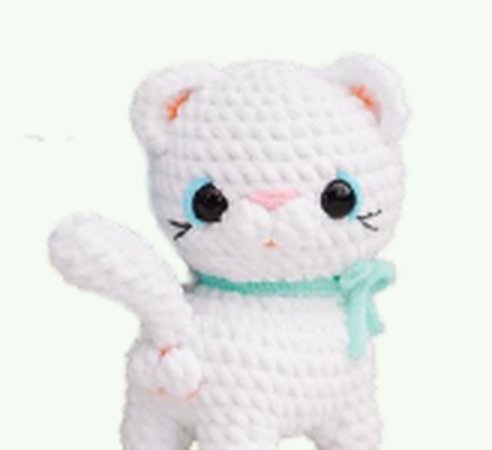
White kitty
White yarn for body, legs, tail, and ears; about 60 g.
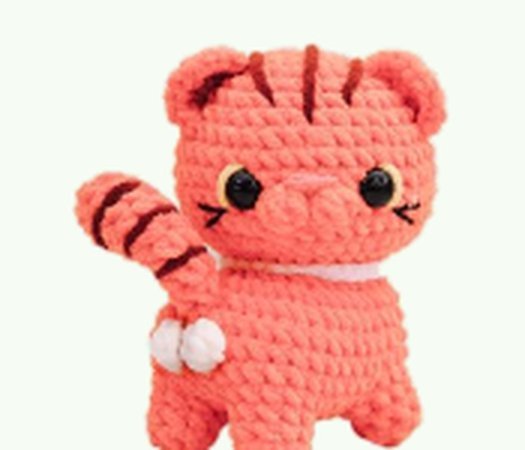
Tabby kitty
Orange body, legs, tail, and ears; cream bobbles in Round 20 and brown embroidered stripes.
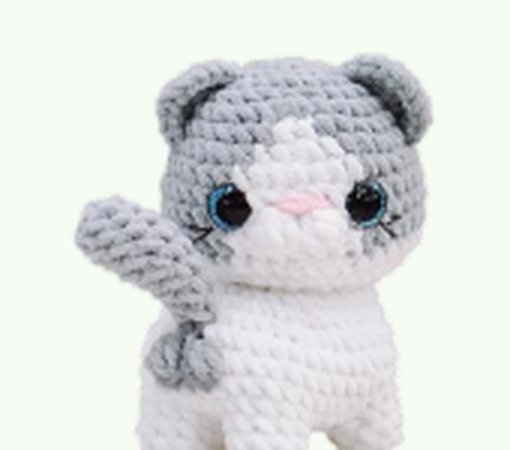
Ragdoll kitty
Gray and white head; white lower body and legs, gray ears and tail.
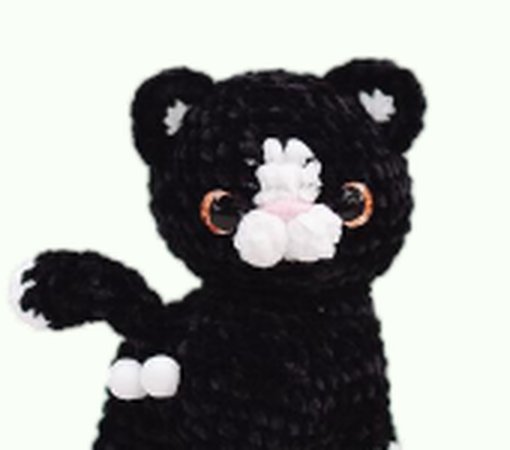
Tuxedo kitty
Black body and ears with white face markings; white on the last leg round and the beginning of the tail.
Finishing and optional decorations
Embroider the tabby stripes on the top of the head and along the tail using brown or another dark yarn. Add a little blush to the recessed areas if desired. A narrow 4–8 mm chenille stem can be bent into a neck bow, or use a crocheted tie of 25 chains with a sewing end. The third illustrated trim is made with 29 chains, then 3 dc in each of 27 stitches beginning in the third chain from the hook, for the stated 81 stitches; sew the resulting ruffle around the neck.
The original also offers an optional squeezable insert: use two small pieces about 4 × 5 cm. In that variant only, replace Round 20 with 19 sc, ch 1 and skip 1 stitch, sc, ch 1 and skip 1 stitch, 18 sc, then position the inserts through the openings and stuff firmly. Keep the sewing needle clear of the inserts when attaching the legs and tail. This is an optional variation; follow the ordinary bobble Round 20 for the photographed basic cats.
For another small plush project, see the Jellyfish Girl crochet pattern.
Leave a Reply